
Daniel Salzler No. 1362 EnviroInsight.org Five Items June 12, 2026
—————Feel Free To Pass This Along To Others——————
If your watershed is doing something you would like others to know about, or you know
of something others can benefit from, let me know and I will place it in this Information .
If you want to be removed from the distribution list, please let me know.
Please note that all meetings listed are open.
Enhance your viewing by downloading the pdf file to view photos, etc.
The attached is all about improving life in the watershed through knowledge.
If you want to be removed from the distribution list,
please let me know. Please note that all meetings listed are open.
Check our website atEnviroInsight.org
- Federal Officials Target ‘Mid- To Late Summer’ For A New Colorado River Plan. The top federal official on the Colorado River said his agency is targeting the middle of this summer to formalize a new water-sharing plan.

Scott Cameron, the acting commissioner of the Bureau of Reclamation, the federal agency which manages the nation’s largest reservoirs, addressed a crowd of water experts in Boulder, Colorado.
“I can’t give you exact dates,” he said, “But I would expect mid to late summer, and as we get closer, we’ll try to signal a bit more precision around that.”
Cameron’s speech, delivered at an annual conference on water policy, was a relatively rare public appearance for the Reclamation chief. He has been working alongside state leaders to craft a new plan for managing shrinking water supplies from the Colorado River.
Cameron may soon depart the position. A water policy expert from California is expected to be nominated for Reclamation commissioner in the coming weeks.
Federal water officials have urged the seven states that use the Colorado River to agree on a plan for sharing its water. If they don’t, Reclamation will likely install its own, but risk getting sued by states that could accuse the federal government of overstepping its authority.
So far, state leaders are at an impasse about those new rules, and a seven-state agreement seems unlikely. Arizona, California and Nevada have banded together to proposetheir own set of rules, and the federal government appears likely to incorporateparts of that proposal in its own plan for the Colorado River.
That three-state proposal relies on the availability of federal money to pay water users who lose some of their share under mandatory cutbacks. Cameron warned that federal money for such programs may be limited going forward.
“I hate to give you all bad news,” he said, “But there isn’t a lot of money left. There just isn’t. There are some folks out there who have sort of bought on to the myth that we’re sitting on two or three or $4 billion. I’m sorry to tell you, we aren’t. “It’s much, much less, less than that. It’s south of $100 million at this point.” Source: KJZZ Phoenix June 5, 2026
2. Colorado River Leaders Must Act Soon To Avoid ‘Devastating Consequences,’ Report Says. A new report from a group of widely respected Colorado River experts says the region’s major reservoirs are sliding toward “devastating consequences” as water levels continue to drop.
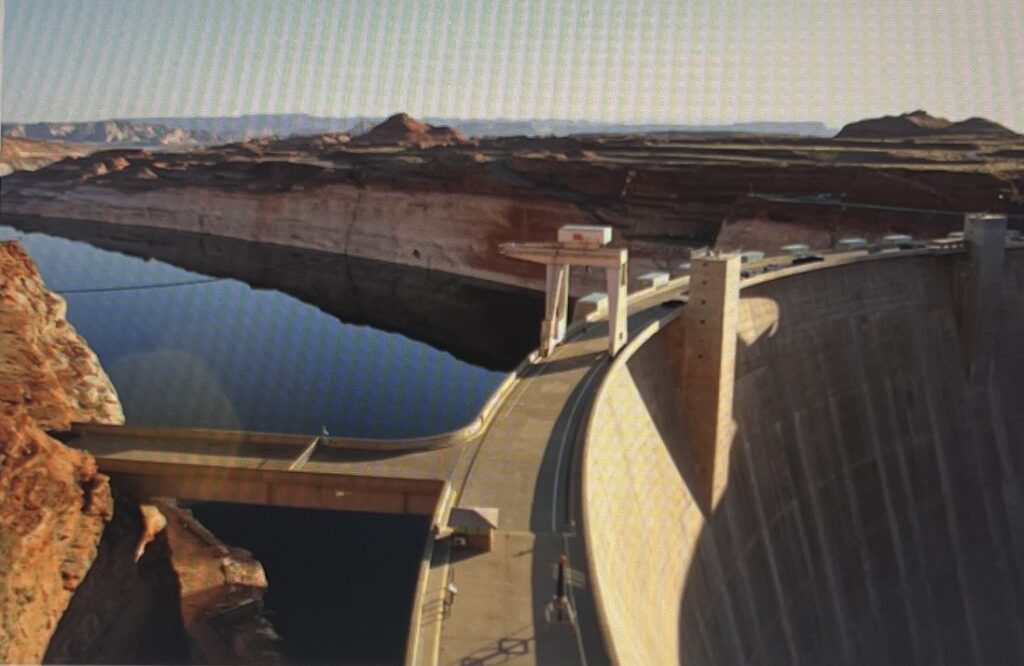
The authors write that another dry year, on the heels of last winter’srecord-setting dry conditions, would send the nation’s largest reservoirs to “run-of-the-river” levels, meaning that they are unable to store water for the future, and simply pass water downstream.
As a result, the paper’s authors — a group of academics and retired water officials — are calling on state water managers and the federal government to work quickly on new rules for sharing the Colorado River and avert infrastructure problems at Lake Powell and Lake Mead, the nation’s two largest reservoirs. Parts of both reservoirs are in Arizona.
“This is an imminent possibility that we could lose the benefit of these very expensively constructed reservoirs,” said Anne Castle, one of the paper’s authors, “And the only way to prevent that from happening is to have significant reductions in consumptive use right now.”
Even a very wet winter, Castle wrote, would provide only about two years of cushion before conditions returned to today’s on-the-brink low levels.
A recently announced plan to prop up Lake Powell has the federal government sending water downstream from a reservoir in Utah and Wyoming. It’s designed to stave off infrastructure problems at northern Arizona’s Glen Canyon Dam in the short term.
Castle said that kind of creative accounting will not work in the long term.
“In order to stabilize the system, we don’t have the luxury anymore of propping up the gap between supply and demand with stored water,” she said. “We have to be able to cut sufficiently to offset that current gap between supply and demand.”
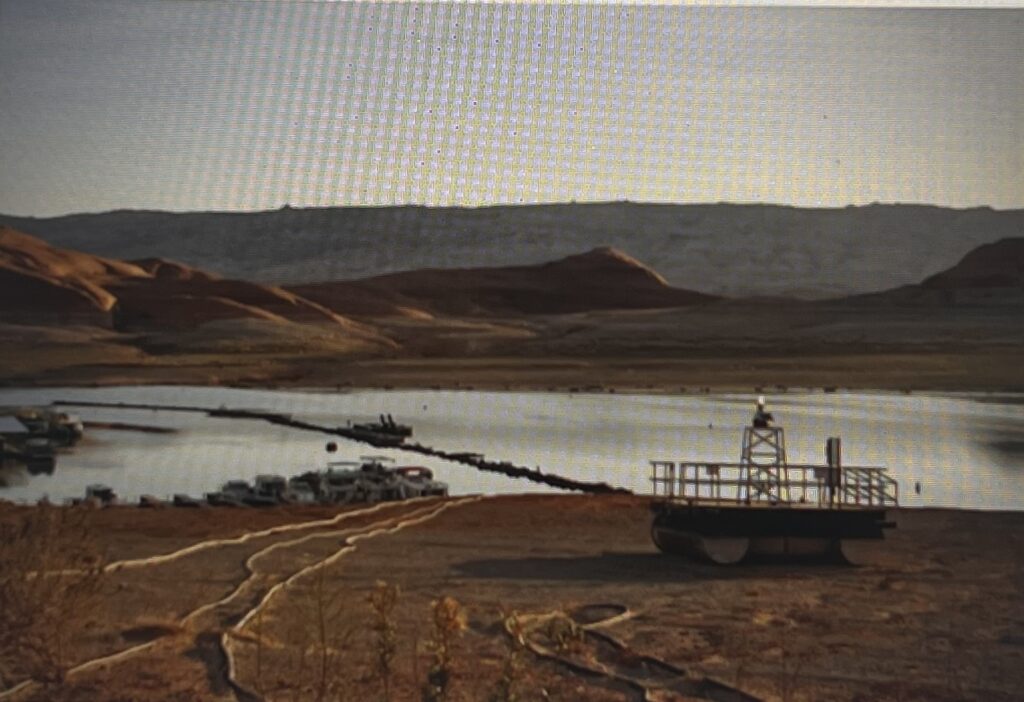
The paper points out that federal data on reservoir levels typically focus on the total amount of water stored, a fact that obscures the reality of how those reservoirs work. The federal government keeps a minimum amount of water in Lake Mead and Lake Powell, to make sure there’s enough to run through hydroelectric turbines inside the dams that hold them back. The amount of water available for cities, farms and tribes to use is the amount that sits on top of that minimum.
“We can be lulled into complacency if we just focus on what’s called the active storage in the system,” Castle said, “Because not all of that water is available for us to use, so one important goal of this paper is to provide a more realistic analysis of how much water is available to us.”
Focusing on the amount above the minimum threshold should add some urgency to ongoing negotiations about sharing water in the future, the report writes.
Those talks are largely at an impasse, and the seven states that use the river appear unlikely to reach an agreement about how to divide water amongst themselves.
A proposal from Arizona, California and Nevada offers some major cutbacks to water use in those states, and will likely help inform thenext set of federal rules for managing the Colorado River.
Nearly 40 million people use the Colorado River between Wyoming and San Diego. Castle said more of them need to call for action from policymakers.
“We need the normal people who turn on their taps and take showers and flush toilets and irrigate crops,” she said. “Those are the folks who will be affected by a system crash, and all of us need to let our leadership know that we understand that we’re going to have to use less water, and we want that to happen, so that the whole system stays afloat.”Source: KJZZ May 5, 2026.
3. Hoover Dam Approaches A Hydropower Cliff. Big cuts in generating capacity are coming.
KEY POINTS
Hoover Dam will see big reductions in hydropower capacity when Lake Mead drops below elevation 1,035 feet, which is 15 feet away.
There will be repercussions for power customers and the electric grid alike, including higher costs.
Grid specialists are working to model low hydropower generation scenarios to understand the risks better.
Some day in the next 12 months – maybe in late-August, maybe not until next spring – Lake Mead will drop below the critical threshold of 1,035 feet above sea level.
That is the water-level elevation at which hydropower generating capacity at Hoover Dam, the largest in the Colorado River basin, will be cut by 70 percent. The drastic and immediate reduction in a cheap source of power that is responsive to hourly changes in electricity demand will have consequences for the region’s power customers and the broader electric grid alike.
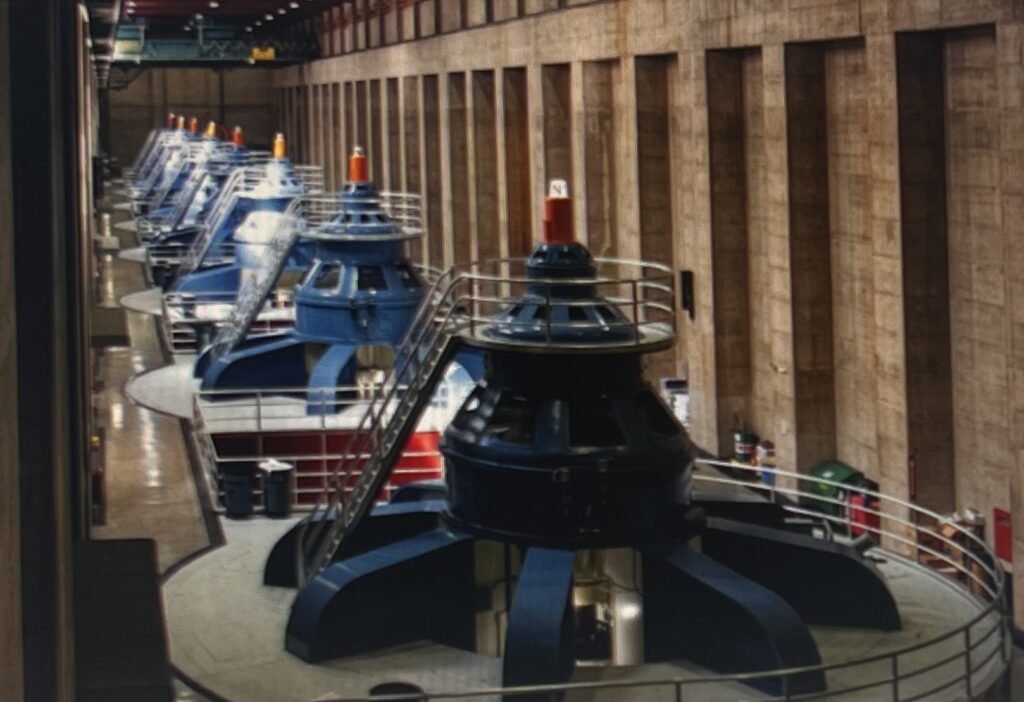
Water managers have known for at least a year and a half that elevation 1,035 feet will be a problem for Hoover’s hydropower. Twelve of the dam’s 17 turbines are not designed to operate in low-water conditions that would be present when Mead is below that level. After record-low winter runoff into already-depleted reservoirs, water managers now know that the day of reckoning is coming soon.
“We’re going to go to 1,035,” Tom Buschatzke, director of the Arizona Department of Water Resources, said at a meeting in mid-May. “There’s no question that’s going to happen.”
The Colorado River’s big reservoirs, Lakes Mead and Powell, are filled with trip wires – water-level elevations that, once breached, trigger a negative outcome. Both reservoirs are low enough that those trip wires for hydropower generation are in sight. With so little water in the system, water managers are in a triage situation, trying to minimize damage but acknowledging there will be unfortunate tradeoffs.
Some help is on the way. The Bureau of Reclamation, the federal agency that manages the dams, announced on May 21 that it will spend $52 million on three new wide-head turbines that will be able to generate power down to elevation 950 feet.
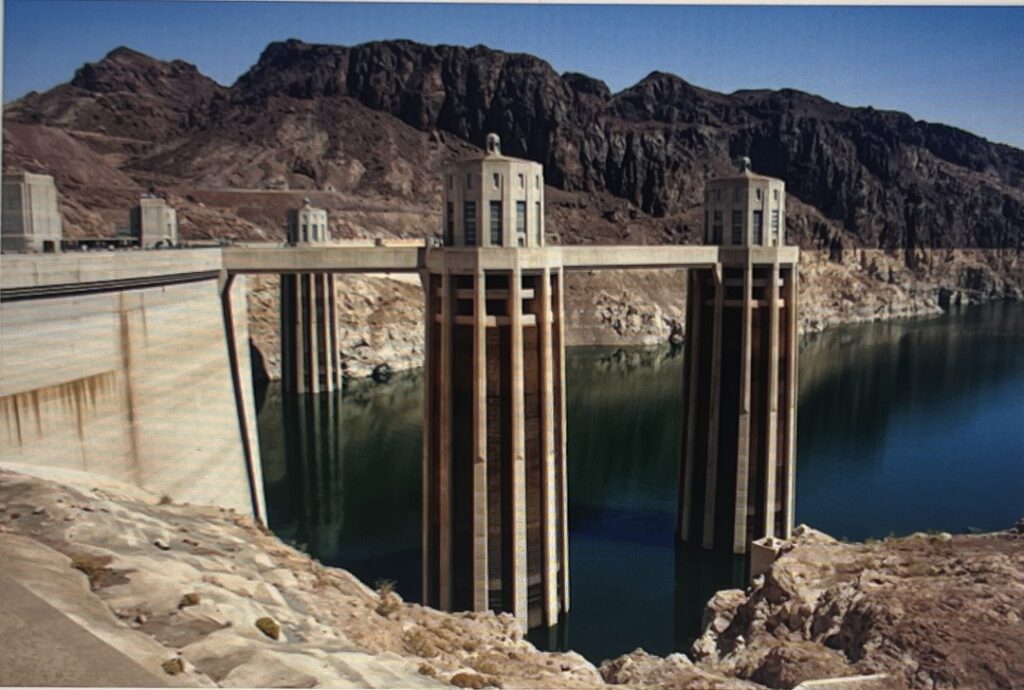
“Unlocking these funds allows us to move forward with critical upgrades at one of the nation’s most important hydropower facilities,” said Scott Cameron, acting Reclamation commissioner, in a press release.
Once those turbines are installed and join the existing five wide-head units, the cut to generating capacity when Mead drops below 1,035 feet will be 58% – less, but still significant. Reclamation’s press office did not respond to questions about the installation timeline before publication.
Hoover Dam’s hydropower is in jeopardy because of problems upstream at Glen Canyon Dam, which forms Lake Powell. In April, the Bureau of Reclamation decided to reduce water releases out of Powell this year by 20%. That stop-gap decision was made to protect Glen Canyon’s fragile water-delivery infrastructure and to enable hydropower generation to continue. Without holding back water – and at the same time releasing more water from upstream reservoirs – Powell would have dropped below its hydropower trip wire by the end of the summer.
Less water flowing out of Powell comes with an unfortunate side effect: the acceleration of Mead’s decline. Earlier this month, Mead was dropping roughly one foot every five days. It is now at 1,050 feet. At this rate, the 1,035 mark will be breached later this summer.
There is much uncertainty to that timeline, though. The lower basin states of Arizona, California, and Nevada have proposed a conservation plan that might keep Mead above 1,035 until next spring. Mead’s rate of decline in the last week was a foot every five to seven days. The timing of the cliff depends on conservation, summer heat, and whatever moisture the summer monsoon brings.
That means a lot of watching and recalibrating, said Dane Bradfield, general manager of Lincoln County Power District, in eastern Nevada.
“It’s not a kick-back summer by any means,” he said.
Rising Costs
Because his district has a contract for Hoover power, Bradfield is among those deep in the trenches. Hoover’s power customers are feeling the repercussions of declining hydropower generation.
Lincoln County Power District has more skin in the game than most. The district, which serves about 5,000 people in a county north of Las Vegas, gets about 70 percent of its electricity from Hoover.
The district forecasts power generation and demand. It then attempts to hedge against any shortfall with market contracts. Even with Hoover’s struggles, Bradfield said he is confident the district has secured enough power through 2026. He’s now looking ahead to 2027. Fortunately, market conditions are favorable right now.
“Our prices are somewhat low from what we’ve seen maybe a year or two ago, but it all changes so fast,” Bradfield said. “And that’s the volatility of the market and also the risk. But our plan right now is to make those purchases a year in advance and just be ready for when the bottom falls out of it.”
Lincoln County has also been acquiring solar power resources, which helped to cushion the hydropower shortfall that already occurred. Hoover’s output today is between 40% and 50%
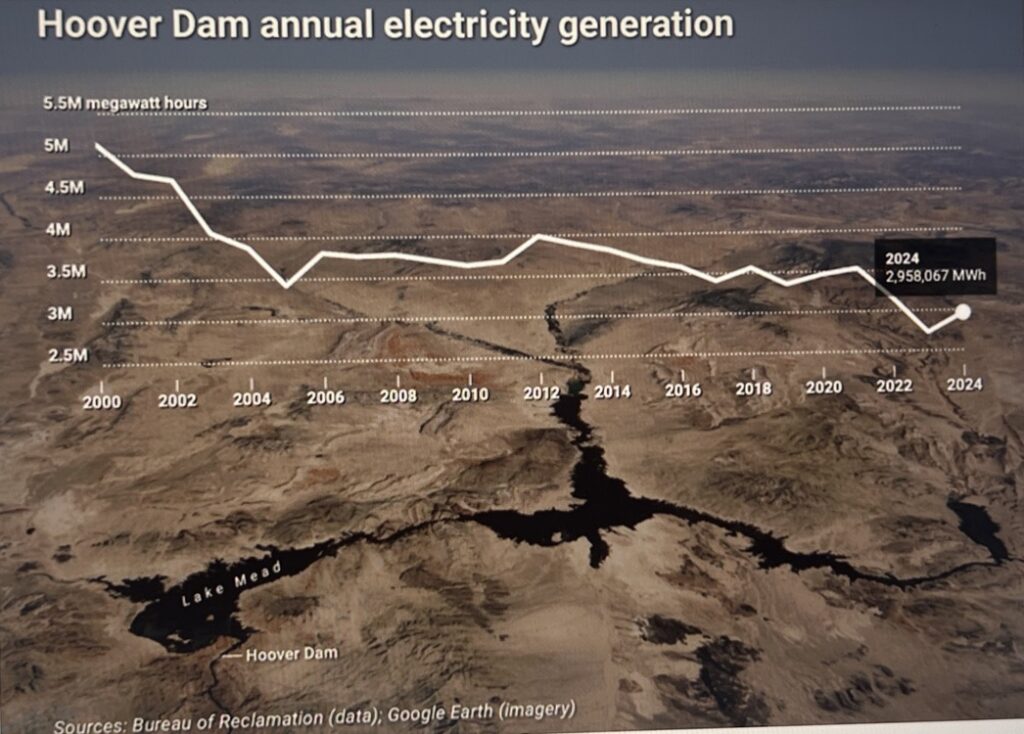
lower than it was in 2000, when Mead was full and Lincoln County received all of its power from Hoover.
Hydropower has traditionally been a cheap source of electricity. That might no longer be the case if Mead topples over the 1,035 cliff, cautions Jordy Fuentes, executive director of the Arizona Power Authority, which markets Arizona’s share of Hoover’s electricity.
The rate that Arizona customers pay for Hoover hydropower includes not only the cost of operations and maintenance at the dam but also visitor center operations, ecosystem protections, and repayment of the construction cost for the Central Arizona Project canal.
The consequences for the rate when generation drops amounts to basic math: less hydropower to sell means the price for each unit of electricity must increase to cover the fixed costs. Therefore, more expensive hydropower. Fuentes reckons the rate could triple, but the timing is uncertain.
“Will there be a lag in how they recover those costs?” Fuentes asks. “Or is there a period of time with a hole in the budget?”
Bradfield is having the same affordability conversations.
“We are anticipating that the cost of hydropower will probably go up,” he said. “And that’s another discussion that we’re having both internally and in the West is how much and when does that get to a point where that resource is priced out by other resources? Because typically hydropower has been the cheapest.”
Grid Strain
Power customers are one area of concern. The other is the electricity grid itself.
Hydropower is valuable not just for the electricity it generates but also for maintaining a steady flow of power from source to home. Hydropower can respond almost instantly to changes in electricity demand, like those that happen in the early evening when air temperatures are hottest and people return from work to cook dinner, wash clothes, and recharge their gadgets. It is an extremely inexpensive way to provide ramping services to the grid, said Nathalie Voisin of Pacific Northwest National Laboratory.
Voisin said the Colorado River emergency is demonstrating the opportunities for more joint management of water and energy resources.
“This doesn’t mean that the grid is going to go dark,” Voisin said. “It just means that other resources are being used to compensate for those services, and it’s just more expensive.”
A drastic decline in Hoover’s capacity will certainly have some grid effect. How large? That remains to be seen, said Katie Rogers, manager of reliability assessment for the Western Electricity Coordinating Council.
WECC is a regional organization tasked with keeping an eye on the grid in the western states. Its grid reliability assessments feed into the big national reports from the North American Electric Reliability Corporation.
WECC’s 2026 summer outlook speaks in general terms about drought, extreme heat, wildfire, and diminished hydropower output. Those risks, individually or in concert, influence electricity availability and demand.
“We have to not just look at that one initial risk,” said Brian D’Agostino from San Diego Gas and Electric during a WECC webinar in early May. “We have to start looking at what happens when we combine two or three of these simultaneously and how do we prepare for that as a region.”
Rogers said that WECC is now collaborating with hydrologists and scientists at Pacific Northwest National Laboratory and the National Laboratory of the Rockies to evaluate how grid operations would be affected by a drastic loss of capacity at Hoover. Their computer models allow them essentially to turn Hoover off and see how the grid responds under different weather, power generation, and electricity demand scenarios. Will the increase in large-scale battery storage offset a decline in Hoover’s ramping capability? Is a spring heat wave more problematic than a summer temperature spike?
“We do those ‘what if’ scenarios and your question is spot on – can the other areas of the grid compensate for what may be lost?” Rogers said. “And we don’t necessarily have answers to those questions, but those are the exact kinds of questions we try to get at.”
Those questions are timely – and, for the time being, timeless. A warming climate is reducing water availability in the Colorado River basin. These pressures on hydropower from low reservoir levels are not likely to let up.
“Absent some hydrology changes, the hydropower resource at both the upper basin and the lower basin is absolutely in trouble and directly related to drought,” Fuentes said.
This story was produced by Circle of Blue, in partnership with The Water Desk at the University of Colorado Boulder’s Center for Environmental Journalism. May 31, 2026.
4. Az Dept Of Water Resources The next Drought Monitoring Technical Committee (MTC) meeting will be held as a hybrid meeting (virtually with an in-person option) on Tuesday, July 14 at 10:00am – 12:00pm (Phoenix time).

You can attend the webinar and/or call in to participate virtually in the discussion using the following information:
Link: https://meet.google.com/dqw-mhtz-iid
Or dial: (US) +1 301-845-5216 PIN: 831 465 883#
If you plan to attend in-person, please email arizonadrought@azwater.gov so we may prepare accordingly. The meeting will be held in the Arizona Department of Water Resources building (1110 W. Washington St. Ste. 301 Phoenix, AZ 85007), in the Thunder River Conference Room.
Mark Your Calendars!
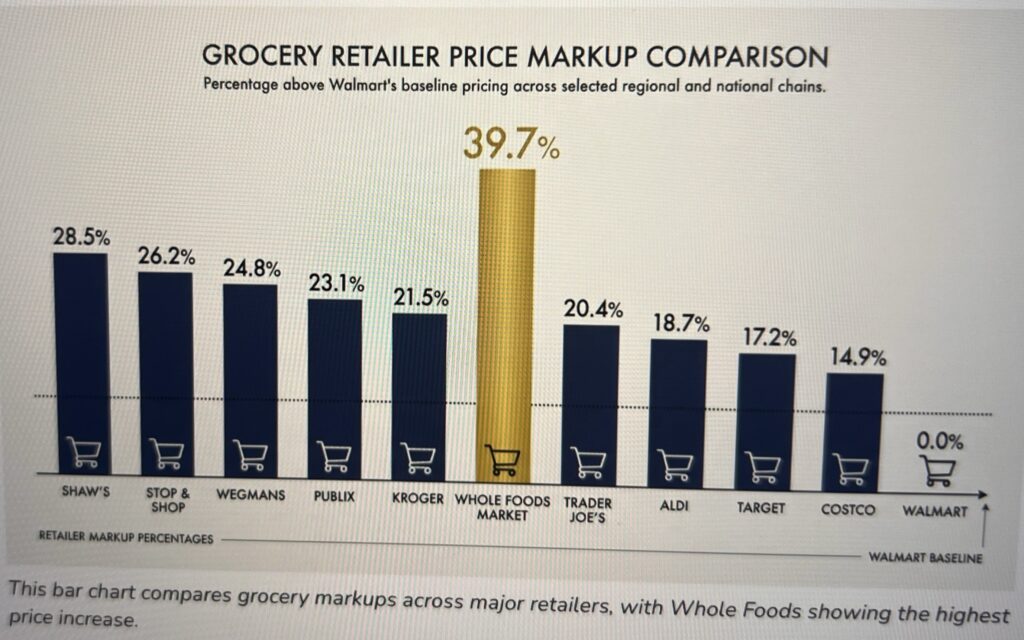
5. Grocery Stores With The Steepest Markups.
Copyright 2026 @ EnviroInsight.org
