
Daniel Salzler No. 1309
EnviroInsight.org Four Items June 6, 2025
—————Feel Free To Pass This Along To Others——————
If your watershed is doing something you would like others to know about, or you know
of something others can benefit from, let me know and I will place it in this Information .
If you want to be removed from the distribution list, please let me know.
Please note that all meetings listed are open.
Enhance your viewing by downloading the pdf file to view photos, etc.
The attached is all about improving life in the watershed through knowledge.
If you want to be removed from the distribution list,
please let me know. Please note that all meetings listed are open.
Check our website at EnviroInsight.org
1. Advanced Water Purification Approved in Arizona, Paving the Way for Sustainable Drinking Water Supply Posted On: Mar. 5th, 2025 – 10:23 am
Approved by the Arizona Governor’s Regulatory Review Council, the new program supplements community drinking water portfolios with a reliable, local source amid rising demand and drought conditions.
PHOENIX (March 5, 2025) – The Arizona Department of Environmental Quality (ADEQ) is pleased to announce that the Governor’s Regulatory Review Council (GRRC) has approved the state’s Advanced Water Purification (AWP) rules, marking a major milestone in securing Arizona’s long-term water resilience. This approval makes the AWP rules effective, establishing a comprehensive regulatory framework that ensures the safe and reliable purification of treated water for potable use while supporting a sustainable water supply for communities statewide.
With GRRC’s approval and the subsequent filing with the Arizona Secretary of State, the rules are effective, allowing Arizona cities and water providers the ability to apply for an AWP permit. This development provides a crucial tool for managing water resources amid ongoing drought conditions and increasing demand.
“This is a landmark achievement for Arizona’s water security,” said ADEQ Director Karen Peters. “Advanced Water Purification provides a cutting-edge solution to support growing communities, safeguard public health, and maximize our state’s water resources.”
The AWP regulatory program was built to provide flexibility to applicants and permittees, while, at the same time, requiring rigorous safeguards to protect public health. Important safeguarding requirements built into the program rules include:
- Initial Source Water Characterization (initially identifying all problem constituents in the treated wastewater source)
- Pathogen Control (mandatory removal well above the 99 percentile)
- Site-specific or custom Chemical Control (a robust and apt approach based on the Initial Source Water Characterization)
- Enhanced Source Control (Chemical Control at the pollutant’s source, if necessary)
- Rigorous Minimum Design Criteria (tailored to the findings of the Initial Source Water Characterization)
“As water challenges grow, many local municipal water providers must boost their water supplies and strengthen long-term water security. Advanced Water Purification is a viable near-term solution to ensure safe, reliable drinking water, which is crucial for Arizona’s water future,” stated Arizona Municipal Water Users Association (AMWUA) Executive Director Warren Tenney.
GRRC’s approval follows an extensive public engagement process, including stakeholder input and technical reviews, ensuring that Arizona’s AWP rules reflect the highest standards in water treatment. The new rule outlines the technical and operational requirements for AWP systems, drawing on best practices, input from the ADEQ-formed external Technical Advisory Group, and feedback on both ADEQ’s AWP Proposed Program Roadmap and Rule.|
Phoenix and Scottsdale, two of Arizona’s largest cities, have been actively involved in developing and supporting the AWP rule.
“We welcome this critical step in the broad standardization of Advanced Water Purification (AWP) here in Arizona and look forward to working with all the partners involved in this process,” said Kevin Rose, acting Water Services Director for the City of Scottsdale.
“Water reliability is the foundation of a thriving community, and the approval of these rules paves the way for new opportunities to strengthen our supply,” said Phoenix Water Services Director Troy Hayes. “Phoenix is prepared to integrate advanced water purification into our long-term strategy, reinforcing our commitment to sustainability and resilience.”
The AWP rule took effect on March 4, 2025, the same day as the GRRC approval and ADEQ’s filing of the rule with the Secretary of State. The Secretary of State will be publishing the final rule in the Arizona Administrative Register in the coming weeks and codifying the rules in the Arizona Administrative Code thereafter. ADEQ will continue working closely with municipalities, water providers, and stakeholders to support the implementation of AWP projects.
For more information about the Advanced Water Purification Rule | View Webpage >
Source: Arizona Water News
2. ASU Launches Center To Enhance Water Quality, Sustainably. Global Center for Water Technology introduced at DC event on May 19.
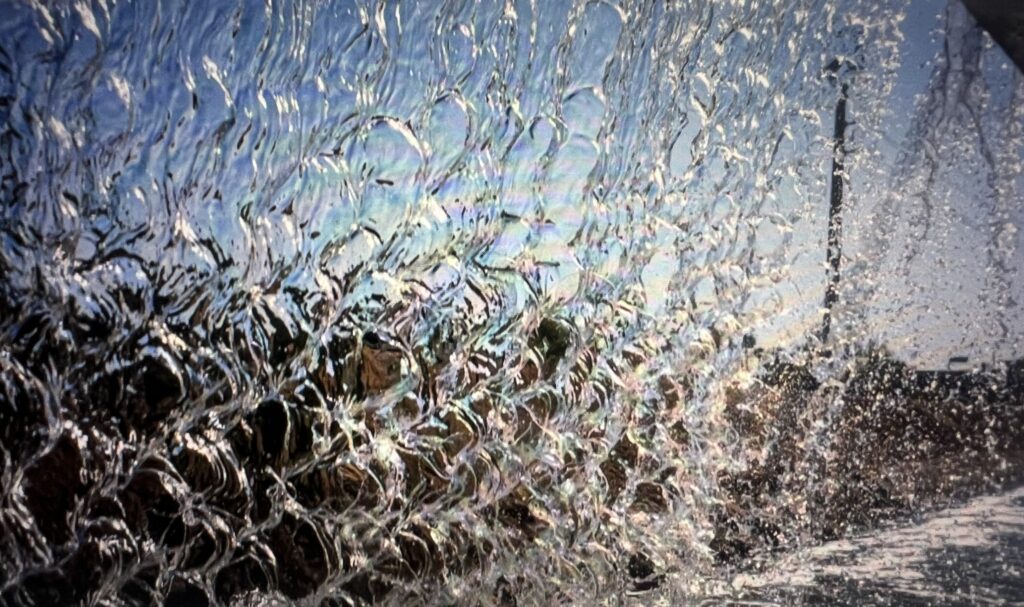
Just five years ago in the U.S., the electric power sector used 47.5 trillion gallons of water — equivalent to approximately 72,000,000 Olympic-sized swimming pools.
Water and energy play a vital role in every part of our society. They are closely related; water is needed to produce energy, and water cannot be moved without energy.
“We’re really trying to push these boundaries of, you know, what is it? What does water and energy mean?” said Paul Westerhoff in an interview before a recent event on the relationship between water and energy at the Barrett & O’Connor Center in Washington, D.C.
On May 19, Westerhoff — who is the deputy director of the National Science Foundation Nanosystems Engineering Research Center for Nanotechnology Enabled Water Treatment, an interdisciplinary, multi-institution nanosystems engineering research center headquartered at Rice University — kicked off the event, acknowledging the launch of ASU’s Global Center for Water Technology, which he’ll be leading.
Part of ASU’s ongoing work with the Arizona Water Innovation Initiative, which began in 2022, the new center will advance innovative technologies that enhance water quality while generating an additional 250,000 acre-feet per year of sustainable water annually within a decade.
The center’s work will be for and about Arizona: “We looked at what do we need in Arizona that Arizona State University can provide,” Westerhoff said.
As the demand for both water and energy rise, leaders from across the sector are working together and forming partnerships to work together on new, sustainable strategies.
Hosted by ASU’s School of Sustainable Engineering and the Built Environment — part of Ira A. Fulton Schools of Engineering — in collaboration with Rice University, the back-to-back event in D.C. discussed challenges in water and energy policy and how the center may help shape the future of these interconnected systems.
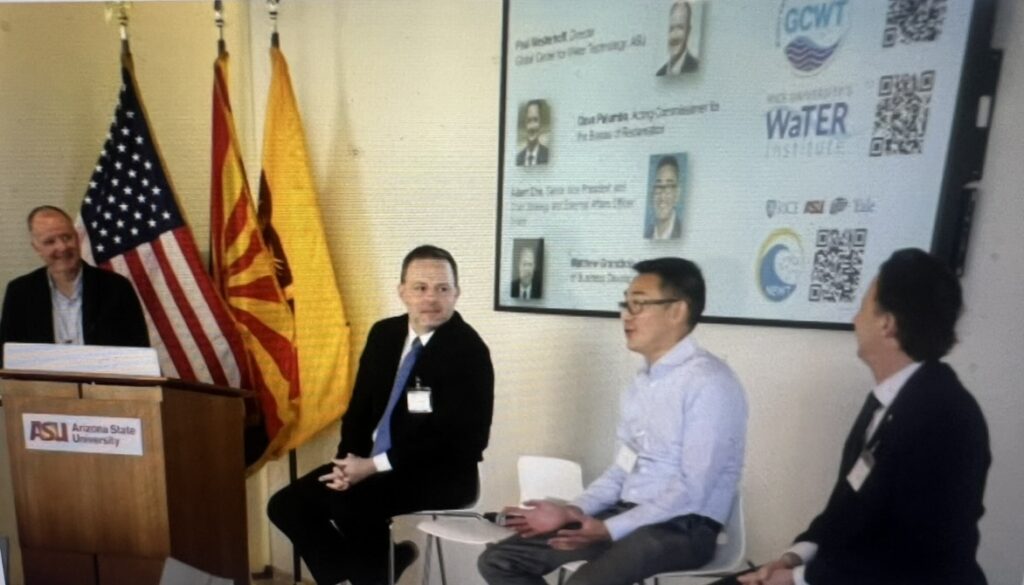
From left: Paul Westerhoff, director of the new Global Center for Water Technology at ASU; Matthew Grandbois, vice president of business development at AirJoule; Albert Cho, senior vice president and chief strategy and external affairs officer at Xylem; and Dave Palumbo, acting commissioner for the Bureau of Reclamation, discuss the importance of water in daily life and energy at a May 19 event in D.C.
Out with the old, in with the new — or nano
“Nanotechnology can help us solve a number of hard challenges. There are 43 million Americans who lack access to municipal water, and industries in remote locations need water treatment and reuse,” said Pedro Alvarez, director of the Rice Water Institute at Rice University.
“But nanotechnology can also help save energy by tapping local, unconventional sources of water, which helps avoid transport of water, which is a heavy commodity over long distances.”
The complex filtration systems of nanotechnology can provide contaminant-free water that is very useful for advanced oxidation processes or advanced reduction processes. Alvarez said that the emerging technology will improve the efficiency of water delivery and represents an enormous step forward from outdated, leaky and aging water infrastructure dating back to the Victorian era.
Policy issues also come into play.
Michelle Foss, a fellow at the Baker Institute, shared a story about one mining company that has treated the water in the Southeast Missouri Lead Mining District — known to be one of the leading producers of lead in the world.
Because of the stigma around lead toxicity and the surrounding mining area itself, people were afraid of possible contamination, even when the company followed EPA and Missouri requirements.
Managing supply and demand with less water and energy
At the event in D.C., Dave Palumbo, acting commissioner of the Bureau of Reclamation, highlighted the relationship between what happens when water levels drop and what that means for hydropower generation.
Palumbo, who oversees the bureau’s dams, power plants and canals across 17 Western states, described the region as the largest wholesaler of water in U.S. and second-largest producer of hydropower and the close links in the region between water and energy.
“As our reservoirs decline in the Colorado River Basin, just looking at Hoover and Glen Canyon … the two largest reservoirs in the United States, they’re about 35% full. It’s a constant cycle as that fortification manifests itself in less water behind reservoirs. This means less energy produced. It means higher cost to move that water,” Palumbo said.
Through this academic cross-partnership with the NEWT Center, ASU — alongside Rice University, the University of Texas at El Paso and Yale University — has worked with more than 50 partners, like Shell, Baker Hughes, UNESCO, the U.S. Army Corps of Engineers and NASA to protect human lives and support sustainable economic development with innovative technology. Source: ASU
3. Kitchen Cutting Boards, There are 200 X more bacteria on wooden cutting boards in your kitchen than on your toilet seat. Perhaps it’s time for a little more Clorox on your cutting board . Source: Wine and More.
4. ASU Climatologist Forecasts A Stormy Summer. Erinanne Saffell says Arizona might see a wetter monsoon this year.
Discussing the weather is small talk for most of us.But ask Erinanne Saffell her thoughts on the topic and you may be flooded with details about everything from the drought to dust storms.
Saffell is the Arizona state climatologist and an associate teaching professor at Arizona State University’s School of Geographical Sciences and Urban Planning.
From her office in the Walton Center for Planetary Health, the Global Futures scientist follows the atmosphere through weather models, real-time online weather observations, radar and satellite. And the five large windows in her office provide a perfect place for weather watching.
On the ground, she uses hundreds of weather stations across the state to track dangerous heat conditions.
And while people typically slow down during the summer, things heat up for Saffell, as she follows flash floods, thunderstorms and other weather patterns that are less predictable than the sunny days that dominate most of the year.
“It’s thrilling to be able to serve the state I was born in by helping communities, agencies and the public understand Arizona’s weather and climate,” said Saffell, who earned a bachelor’s, master’s and doctoral degree in geography from ASU.
ASU News recently spoke with Saffell about her summer forecast and how she and her staff plan to weather the season.
Question: While people are winding down during the summer, you are entering your busy season. What are summers like for Arizona’s state climatologist?
Answer: One of the more exciting times of year is the monsoon season. It’s almost like following a sports game because you might be familiar with the players and think you know the outcomes, but there are alway uncertain factors.
When you watch cumulus clouds form in the summer, you can see the clouds getting bigger and taller in the sky. Will there be enough of all the ingredients in the right location to drop rain out of the sky? That’s what we watch for!

Every summer is different, but I start paying close attention to the atmospheric thunderstorm ingredients in April and May. If everything works perfectly, Arizona can start seeing thunderstorms in late June or early July. The monsoon season is usually initiated by an area of high pressure over the Four Corners region. It helps pull moisture into the state that can trigger monsoon thunderstorms.
Q: Summers seem to be getting longer and hotter and hotter for longer periods of time. Will we be breaking last year’s records?
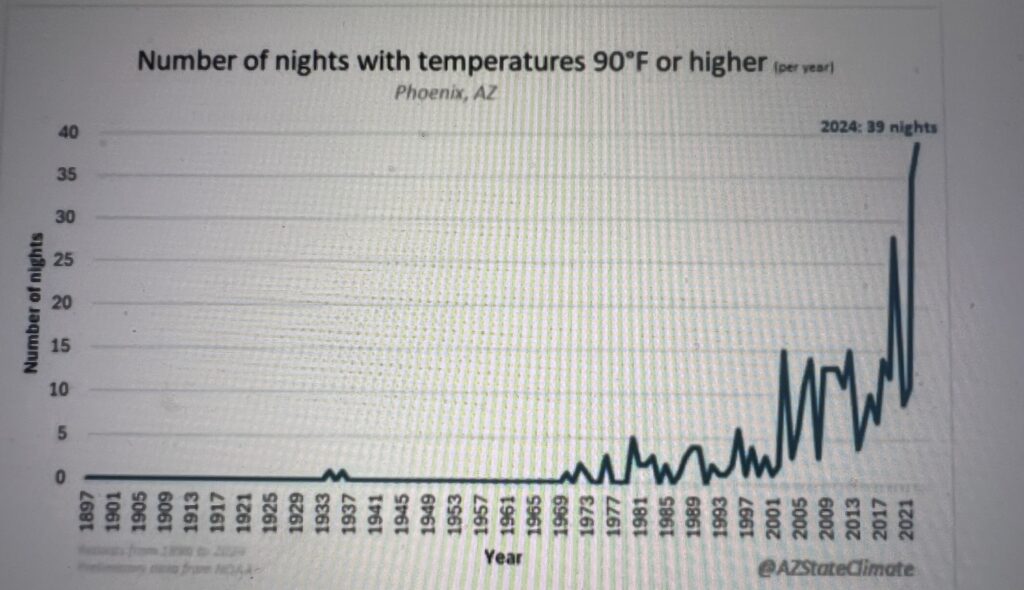
A: Statewide, 2024 ended with the 16th driest and the overall hottest summer on record (June to September) with a record total of 39 nights that didn’t cool off below 90 degrees Fahrenheit.
Nights that the temperature didn’t go below 90 degrees F. Source: Erinanne Saffell
From Sept. 24 to Oct. 14, 2024, a very strong heat wave broke temperature records not only in Arizona but across the Southwest. Arizona set a record for the latest 113 F temperature ever recorded for Phoenix (Oct. 6, 2024). Most 110 F or higher temperatures usually end by mid-September. Fortunately, not every weather record gets broken every year.
A few outlooks are hinting that Arizona might have a wetter monsoon this summer. For the monsoon to start, we pay attention to an area of high pressure called the Monsoon Ridge. Some ingredients that help build the Monsoon Ridge include dry soil moisture after a dry summer and fall, and a dry winter without a lot of snowpack. A lot of these ingredients are in place but we’ll still have to wait and see what happens.
Q: What are your predictions for other summer weather conditions during the monsoon?
A: While some monsoon seasons are more active than others, every summer brings the possibility of dangerous weather across the state. Wildfire activity is often more prominent early in the monsoon season, but wildfire activity can persist during a dry summer. Lightning is the main ignition for wildfires in June. “Dry lightning” is when a thunderstorm could spark ignition yet produce little rainfall, potentially allowing a wildfire to build. Statistically, four people die every year in Arizona from flooding. Sadly, there were two flooding fatalities in Arizona in 2024. Damaging winds and hail are always possible from summer thunderstorms, as are strong downbursts. Dust storms can deliver decreased visibility and poor air quality.
Can everyone know exactly where and when these dangerous conditions will happen? Most Arizonans have experienced a summer where they got clobbered with a strong thunderstorm while their neighbor down the street stayed dry. That’s the nature of Arizona’s convective thunderstorms. Every monsoon season is different, but the potential for dangerous weather happens every summer.
Q: One of your many roles as Arizona state climatologist is to examine historical climate data. What does that entail?
A: I enjoy digging into Arizona’s weather records; they go back over 150 years. Some of the older weather records are only available in my office because the paper is fragile and can’t be digitized. The penmanship is exceptional! We have old newspaper articles from the early 1900s, too. The articles are engaging, fascinating and detailed; people in the early 1900s were just as interested in weather as we are today.
Q: Lastly, any recommendations for keeping Phoenix residents cool during the summer — besides heading for the coast?
A: Arizonans definitely take advantage of the cooler parts of the state during summer, like Flagstaff, Prescott, Payson and Show Low. The Mogollon Rim is also a favorite camping area. Summer thunderstorms usually happen earlier in the afternoon at these higher elevations and can quickly drop hail, lightning and a lot of rain. When hiking or camping this summer, it’s important to plan for the weather.
Copyright 2025c@ EnviroInsight.org
