
Daniel Salzler No. 1349 EnviroInsight.org Seven Items March 13, 2026
—————Feel Free To Pass This Along To Others——————
If your watershed is doing something you would like others to know about, or you know
of something others can benefit from, let me know and I will place it in this Information .
If you want to be removed from the distribution list, please let me know.
Please note that all meetings listed are open.
Enhance your viewing by downloading the pdf file to view photos, etc.
The attached is all about improving life in the watershed through knowledge.
If you want to be removed from the distribution list,
please let me know. Please note that all meetings listed are open.
Check our website at EnviroInsight.org
- We The People Have To Power To Protect Us! Cutting methane pollution is the fastest way to slow climate change. Electric cars, hybrid fueled cars, hydrogen fueled cars all can lower or eliminate the climate changing toxins that fill our air.
When a comes to oil and gas production, the state of New Mexico, home to the largest Permian oil snd gas producing basin, is leading the way in methane cutting procedures. In 2021 New Mexico began requiring a suite of 14 pollution controls in the oil and gas production process. Texas only requires four. The methane pollution levels in Texas are more than twice as high as in New Mexico. For example, methane emissions per unit of production is 1.2% in New Mexico versus 3.1% in Texas.
In other parts of the country, last summer 10 states finalized a compact to produce power from power plants cutting emissions 92% by 2033 compared to 2008. The compact known as the Regional Greenhouse, Gas Initiative or RGGI cut power plant pollution while generating hundreds of millions of dollars annually for states to invest in communities and businesses. Our GGI funding has already supported 8 million families and 400,000 businesses across the northeast and mid Atlantic region of the United States. According to a separate study by the consulting group ABT Associates, found that the program produced $5.7 billion in health benefits over the first 12 years, including fewer premature death, heart attacks and asthma Cases.
All of these pollution-cutting programs have been under attack by the Trump administration, but are also being champion by the Environmental Defense Fund (EDF). The EDFs climatecore has trained and placed more than 2000 graduate students in companies, local governments and community institutions around the world. To advanced climate action now EDF has made some of the programs most important lessons available online for free. A certificate-granting course entitled, “Corporate Climate, Action Elements”, helps professionals, integrate climate strategy into business decision-making. For more information, go to:https://www.edf.org/media/edf-launches-free-e-learning-course-equip-workers-climate-action-skills
Source: EDF.org
2. Just Climbed Out From Under A Rock? Times Have Changed. In case you missed it, last Sunday, the U.S. changed to Daylight Savings Time. So, The East Coast people you might know are three (3) hours ahead of us and the West Coast people are on the same time zone as AZ. Source: Editor
3.104(b) Small Research Grants: Deadline Extended and Award Amount Increased. For the upcoming cycle, the WRRC expects to receive an increase in funding for small research grants from the US Geological Survey (USGS) through the federal Water Resources Research Act (WRRA) section 104(b) program. With this additional funding, the WRRC is pleased to consider proposals for up to $15,000 in federal funds. Applicants must show a 1:1 match of non-federal to federal dollars. Additionally, the WRRC expects to fund more small research projects this year. The project start date has not yet been confirmed by the USGS; however, the 12-month project period will likely start in January 2027.
The WRRC is currently accepting proposals. The deadline to submit proposals has been extended to 5:00pm MST on Monday, April 20, 2026. The 104(b) program funds university-based research with the intent of improving water supply reliability, exploring solutions to ongoing water issues, supporting new research scientists, and disseminating research results to water managers and the public. As always, projects must include support for student involvement.
4. Big Decisions Loom for a Rapidly Shrinking Lake Powell Reclamation considers actions to prop up the Colorado River’s second-largest reservoir.Officials at the Bureau of Reclamation, the federal agency that manages Colorado River dams, outlined several actions they are considering in the coming months to boost water levels in a rapidly shrinking Lake Powell, which could drop to a record low later this year that would halt hydropower production from Glen Canyon Dam for the first time.
The Colorado River’s second-largest reservoir behind Lake Mead is entering one of the most difficult periods in its six-decade history. The basin is drying due to a warming climate. Powell is just a quarter full, and projected to drop lower this year. Winter has been a dud, with warm temperatures and a historically bad snowpack in the Colorado mountains that feed into the reservoir.
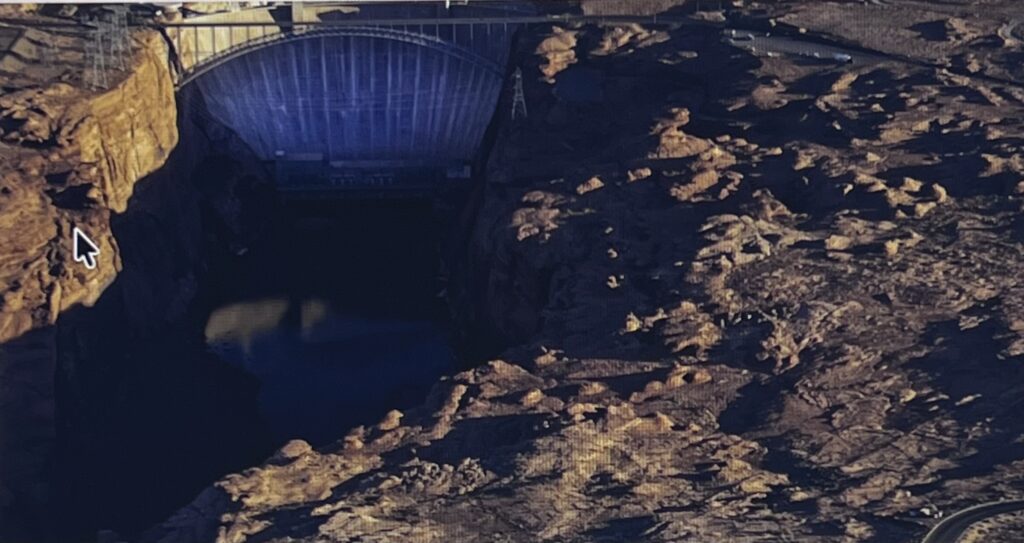
Decisions in the next three months about how much water to release from Powell and how much to hold back will reverberate across the basin, affecting hydropower production, legal obligations, watershed ecology, threatened species, and millions of people who use its water and energy.
“Things are happening in parallel and not in sequence,” said Wayne Pullan, Reclamation’s Upper Colorado Basin regional director. “We’re going to be doing everything all at once.”
Pullan and other Reclamation officials discussed their options during a meeting Wednesday of the Glen Canyon Dam Adaptive Management Work Group, an expert committee that advises on the dam’s ecological impacts.
The number that federal officials are paying attention to is 3,490 feet. Below that point, Glen Canyon Dam cannot produce hydropower. Powell would be too low for water to flow through the power-generating turbines.
A 2024 decision allows Reclamation to “consider all tools that are available” to keep Powell from dropping below 3,500 feet, an elevation that provides a little wiggle room for maintaining hydropower production. Powell today sits at 3,531 feet.
“I think it’s safe for us to assume that unless Mother Nature is uncharacteristically generous, that Lake Powell elevations are going to fluctuate at elevations that we’re not comfortable with,” Pullan said.
The tool from the 2024 decision is Section 6(E), which grants Reclamation the authority to restrict water releases from Powell to as low as 6 million acre-feet. The planned release this Powell, which could drop to a record low later this year that would halt hydropower production from Glen Canyon Dam for the first time.
The Colorado River’s second-largest reservoir behind Lake Mead is entering one of the most difficult periods in its six-decade history. The basin is drying due to a warming climate. Powell is just a quarter full, and projected to drop lower this year. Winter has been a dud, with warm temperatures and a historically bad snowpack in the Colorado mountains that feed into the reservoir.
Decisions in the next three months about how much water to release from Powell and how much to hold back will reverberate across the basin, affecting hydropower production, legal obligations, watershed ecology, threatened species, and millions of people who use its water and energy.
“Things are happening in parallel and not in sequence,” said Wayne Pullan, Reclamation’s Upper Colorado Basin regional director. “We’re going to be doing everything all at once.”
Pullan and other Reclamation officials discussed their options during a meeting Wednesday of the Glen Canyon Dam Adaptive Management Work Group, an expert committee that advises on the dam’s ecological impacts.
The number that federal officials are paying attention to is 3,490 feet. Below that point, Glen Canyon Dam cannot produce hydropower. Powell would be too low for water to flow through the power-generating turbines.
A 2024 decision allows Reclamation to “consider all tools that are available” to keep Powell from dropping below 3,500 feet, an elevation that provides a little wiggle room for maintaining hydropower production. Powell today sits at 3,531 feet.
“I think it’s safe for us to assume that unless Mother Nature is uncharacteristically generous, that Lake Powell elevations are going to fluctuate at elevations that we’re not comfortable with,” Pullan said.
The tool from the 2024 decision is Section 6(E), which grants Reclamation the authority to restrict water releases from Powell to as low as 6 million acre-feet. The planned release this year is 7.48 million acre-feet, so the Section 6(E) authority represents a potential 20 percent reduction.
A cut of that magnitude might not be necessary because Reclamation has another tool it can use in tandem.
That option is releasing more water from Flaming Gorge and other smaller reservoirs located higher in the watershed. This is called a DROA release after its authorizing document. Pullan said this action, which states in the lower basin are advocating for, is being discussed and the volume of those releases would be determined in the spring, around April or May.
“It’s important to remember that this is all in flux,” Pullan said. “This cake is being mixed and isn’t baked in any way yet.”
A previous DROA release in 2022-23 moved 463,000 acre-feet from Flaming Gorge into Lake Powell. Flaming Gorge today is 82 percent full, holding almost 3 million acre-feet.
Reclamation’s current projections show Powell dropping below hydropower production level by December, in an average water supply scenario. If snowpack and runoff continue to run below average, then that threshold could be breached, barring interventions, in August.
Katrina Grantz, Reclamation’s deputy regional director, said that in the most probable water supply scenario the agency has the tools to be able to keep Powell above 3,500 feet over the next 12 months. But it is still analyzing how and when to deploy them.
“Reclamation is working on various scenarios of how this could play out,” Grantz said.
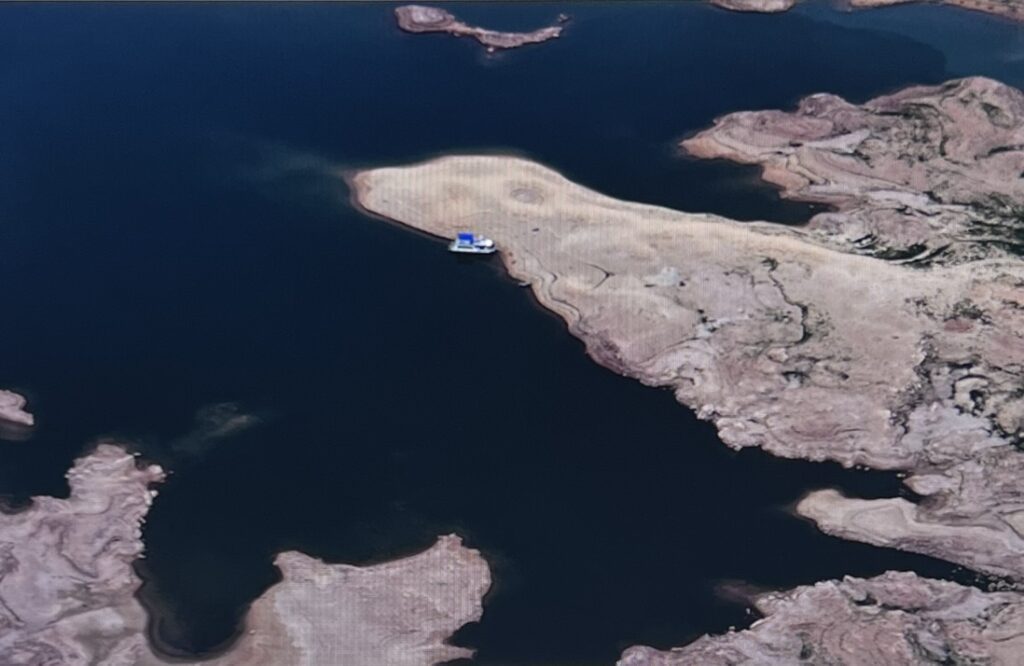
There are other considerations in the mix. Powell is the source of cold-water releases to help native fish. The water this year could be record warm. Powell is also the source of high-volume flows to move sediment that rebuilds Grand Canyon beaches and steadier flows that assist aquatic insects. Releases have implications for boating and recreation, too.
The basin’s abysmal hydrology coincides with deep political and legal uncertainty. Current reservoir management guidelines expire at the end of the year, and the seven basin states have not been able to agree on their replacement. Reclamation instead is forging its own path, aiming to finalize a decision this summer.
Reduced releases from Powell could also cause the four upper basin states – Colorado, New Mexico, Utah, and Wyoming – to violate the Colorado River Compact, which requires a certain volume of water to move downstream. This requirement and its legal ramifications are not clear and could be litigated.
It all amounts to an unsettling time for those working in the basin. “We have to work with the resources we have,” Pullan said. “Wishing will not make things so.”
Source; Circle of blue. Feb 26, 2026
5. AZ Water Leaders Push Back On ‘Unacceptable’ Draft of Federal Plans For Managing Colorado River.Arizona water leaders had some harsh words about a draft of federal plans for managing the Colorado River.
Brenda Burman, general manager of the Central Arizona Project, wrote in a statement that those plans would “disproportionately harm Arizona and are unacceptable.”
The Colorado River is managed according to agreements between the seven states that use it. The current management plan expires this year, and those states have failed to agree on a new deal for sharing water. With states at an impasse, the federal government proposed its own series of options for river management.
Those options, also called “alternatives,” were outlined in a Draft Environmental Impact Statement.
They do not bode well for Arizona.
Water from the Colorado River arrives in Phoenix and Tucson via the Central Arizona Project, a 336-mile system of pipes and canals through the desert.
“The DEIS alternatives threaten to tear apart a generation of careful water management and topple the architecture that supports American semi-conductor manufacturing, AI infrastructure industries, and critical mineral and agricultural production,” Burman wrote.
Under one alternative, 77.4% of cutbacks would be dealt to Arizona, according to CAP. Five of the seven states would face zero cuts under that alternative.
A longstanding legal policy called “prior appropriation” generally means that the first people to use Colorado River water will be the last to lose it in times of shortage. The Central Arizona project is a relative newcomer to that system, leaving some of its users as the first to experience cutbacks as the Colorado River dries up amid a megadrought.
Arizona’s leaders are now saying they won’t take those cutbacks in their current form.
A ‘fatal’ legal flaw
The federal draft included an open comment period, and leaders around the West submitted their thoughts. Arizona officials made their feelings clear: they want those plans to change. Some comments seemed to hint that Arizona could pursue legal action if the draft is implemented unchanged.
Both CAP and the Arizona Department of Water Resources made the case that draft federal plans could trigger a violation of the Colorado River Compact and lead to a lawsuit. That 1922 agreement is the bedrock of Colorado River management and spells out how the river is shared among the seven states that use it. It divides the Colorado River between the Upper Basin states of Colorado, Utah, Wyoming and New Mexico, and the Lower Basin states of Arizona, California and Nevada.
“The failure of the Draft EIS to acknowledge that the Lower Basin states can seek enforcement of the Compact should the Upper Basin fail to comply with its obligations is a fatal flaw,” ADWR wrote in its comments.
A matter of national security
As the threat of deep cutbacks to Arizona’s Colorado River supply have become more imminent, the state’s leaders have begun to ramp up the importance of the industries that use that water.
Water officials and politicians have framed cuts to the Central Arizona Project as a matter of national security.
Two groups of Arizona congresspeople — one Democratic and one Republican — wrote letters to Interior Secretary Doug Burgum, highlighting the importance of Colorado River water to food systems and semiconductor manufacturing in Arizona.
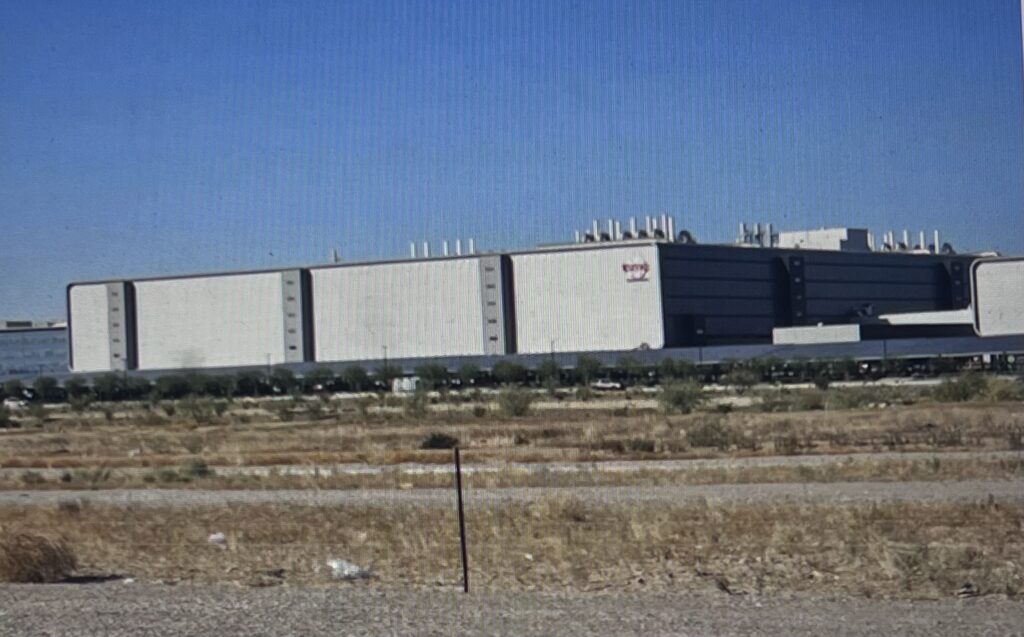
Chelsey Heath/KJZZ The Taiwan Semiconductor Manufacturing Company Limited facility near Interstate 17 and Loop 303 in Phoenix on Monday, Dec. 16, 2024.
“The semiconductors that are being produced at [Taiwan Semiconductor Manufacturing Company] and Intel, not only will power the leading industries of the future,” Congressman Greg Stanton told KJZZ, “but they’ll be powering weapons systems that are so critical for American national defense. We’re doing more of that than any other place in the entire United States of America.”
Stanton said disproportionate cuts to Arizona’s water supply would affect the entire country.
“We’re going through a shared crisis right now, and the best way of handling it is shared sacrifice,” Stanton said. “As fellow Americans, we’re not going to try to put one state in a position where we have to accept the vast disproportionate amount of cuts.”
Engineering solutions
Federal water managers are open about the fact that they would rather not implement their draft plans. They have been asking the states to come to an agreement, but those states have shown little progress. State negotiators blew through a federal deadline in February, but their failure to forge a deal doesn’t seem to have resulted in any material consequences handed down from the federal government.
Meanwhile, the Colorado River faces one of its driest winters in decades, and the amount of water stored in major reservoirs threatens to drop dangerously low.
States have historically dictated plans for sharing the river’s water, but that same water is stored in reservoirs owned by the federal government. At Lake Powell, the nation’s second-largest reservoir, water could soon drop too low to run hydroelectric turbines inside the federally-owned Glen Canyon Dam.
The federal government is considering these draft plans to protect the dam and reservoir.
Some Arizona leaders say the federal government should use a different tool to keep those reservoirs from dropping too low. ADWR’s letter calls on the federal government to release water from other reservoirs upstream of Lake Powell. It’s a strategy that has been used during other recent times of extraordinary water shortages, but is unpopular with Upper Basin leaders. Source : KJZZ
6. Arizona’s Verde River Scores a C+ In New Report Card. Here’s why. A new report card for the Verde River gave the watershed a C+. Environmentalists who watch the river closely say the grade is more than meets the eye.
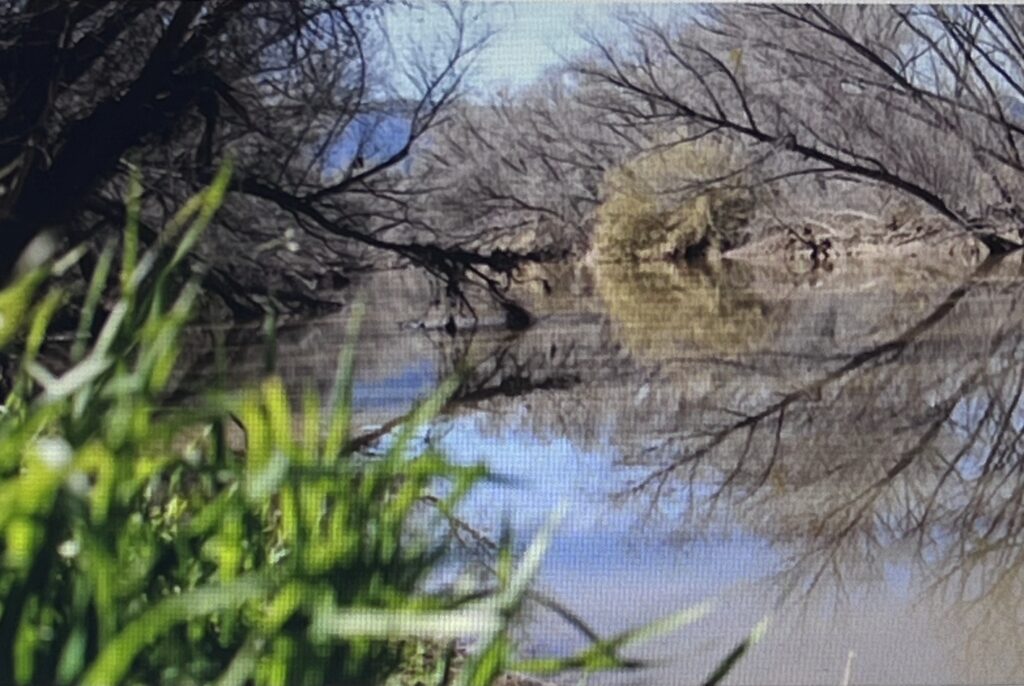
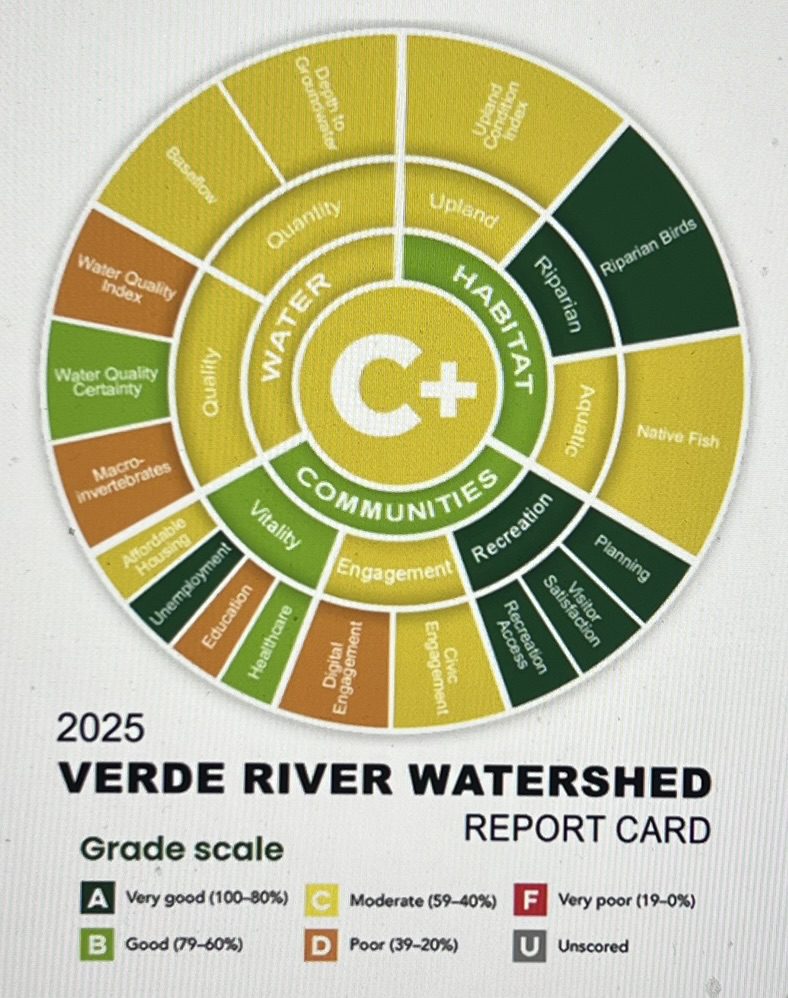
The score comes from the nonprofit groups Friends of the Verde River and The Nature Conservancy. It’s designed to assess the health of the Verde, its tributaries and the communities around them. The watershed scored high in categories like recreation and bird habitat, but received low marks for water quality.
The river runs through northern Arizona before filling reservoirs in the Phoenix area.
An earlier report card, released in 2020, also landed a C+.
David Gressly, executive director of Friends of the Verde River, said the stagnant score partially has to do with how the group measures water quality. The previous report card included a low score for “water quality certainty” which caused the group to ramp up water quality sampling. As a result, the 2025 report card scored high in water quality certainty, but the results of that sampling meant low marks for water quality itself.
Friends Of The Verde River
“Now the certainty is much higher because we actually have a comprehensive program to monitor,” Gressly said, “But at the same time, we’ve discovered there’s some problems, too. So the positive of getting better data also might mean that you’re collecting data that shows some negatives that you weren’t aware of before.”
Gressly said his group is now drawing data from 50 monitoring sites around the watershed and aims to reach 80 in the future.
The 2025 report card also highlighted the importance of macroinvertebrates as indicators of water quality. That term mainly refers to the small, bug-like creatures that flyfishers try to mimic with their lures. Friends of the Verde River said it wants to expand collection of data about macroinvertebrates to get a more robust understanding of water quality.
The “habitat” category of the report showed some of the biggest improvements over the past five years. Riparian bird habitat, meaning areas for birds to live near rivers and streams, got an A grade. Upland habitats – areas further away from the streams themselves – showed some improvement, too, and Gressly said the next few years would bring a push to clear invasive species and keep improving that upland habitat.
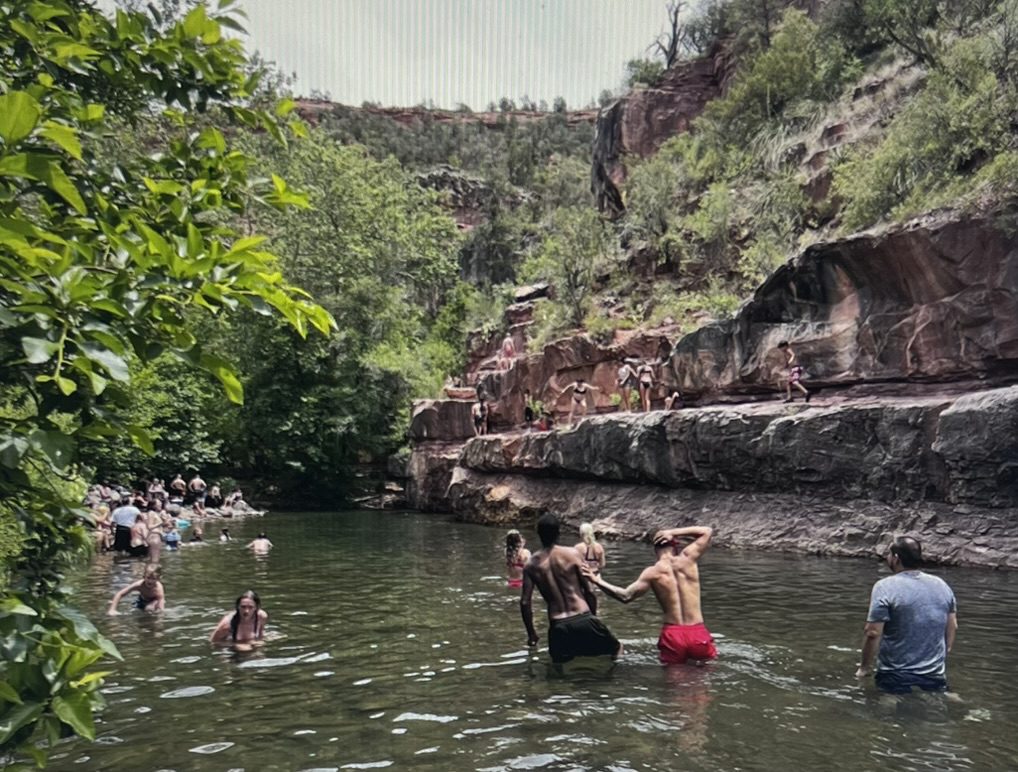
People swim in Oak Creek near Sedona, Arizona on June 9, 2024. The Verde River watershed received high marks for visitor satisfaction, partially thanks to high levels of recreation access.
The report card also spelled out a need to reduce the amount of sediment flowing downstream in the Verde River. Sediment — tiny particles of sand, silt, decomposing plants and other matter — can pile up at the bottom of reservoirs. Sediment buildup is a major driver behind a proposed multibillion-dollar dam expansion at Bartlett Reservoir, which stores water from the Verde River.
Recreation scored high, and the report highlighted strong access for kayaking, swimming and fishing. It noted a need to spread out recreation activities to reduce overuse within the Oak Creek region, which includes heavily trafficked areas near Sedona.
Gressly said adding a second report card to the archive will help identify patterns and lead to better protections for the river in the future.“Now that we have two reports out,” he said, “We have the beginnings of a trend line so that we can really monitor this more effectively across time, and I think it will become increasingly a powerful tool for decision makers to use to make appropriate decisions on safeguarding the watershed.”Source: KJZZ
7. “Friday ‘the 13th” Are You Superstitious? Friday the 13th, date that signifies bad luck in many Western cultures. The superstition is akin to the beliefs that crossing paths with a black cat, walking under a ladder, opening an umbrella indoors, or breaking a mirror bring bad luck. Friday, March 13 is this week.

Friday the 13th, which occurs when the 13th day of a month in the Gregorian calendar falls on a Friday, happens at least once a year and sometimes up to three times a year. On average, one occurs every 212.35 days.
Fear of Friday the 13th causes some people to experience anxiety, which can include physical symptoms such as increased heart rate, sweating, breathing rapidly, or trembling. Psychotherapist Donald Dossey coined the term paraskevidekatriaphobia—derived from the Greek words Paraskevi (“Friday”), triskaideka (“thirteen”), and phobos (“fear”)—to describe the often paralyzing fear individuals experience relating to the date and to diagnose those who suffer from it. The fear is also sometimes diagnosed as friggatriskaidekaphobia, the joining of Frigg (the Norse goddess for whom Friday is named) with the term triskaidekaphobia (fear of the number 13).
Friday the 13th and its association with bad luck was first written about in 19th-century France. An article published in 1834 in the French literary magazine Revue de Paris by Italian author Marquis de Salvo refers to a Sicilian count who killed his daughter on Friday the 13th. The article, titled “Le Chateau de Carini,” states, “It is always Fridays and the number 13 that bring bad luck! Source: Britanica
Copyright 2026 EnviroInsight.org
