
Daniel Salzler No. 1312 EnviroInsight.org Four Items June 27, 2025
—————Feel Free To Pass This Along To Others——————
If your watershed is doing something you would like others to know about, or you know
of something others can benefit from, let me know and I will place it in this Information .
If you want to be removed from the distribution list, please let me know.
Please note that all meetings listed are open.
Enhance your viewing by downloading the pdf file to view photos, etc.
The attached is all about improving life in the watershed through knowledge.
If you want to be removed from the distribution list,
please let me know. Please note that all meetings listed are open.
Check our website at EnviroInsight.org
1. Bureau Of Reclamation Releases Report Of The Lower Santa Cruz Basin. The Lower Santa Cruz River Basin Study explores the challenges and opportunities related to intra-basin water supply and demand imbalances in the Lower Santa Cruz River Basin in southeastern Arizona, also known as the Tucson Active Management Area.

The study is completed in partnership with the Southern Arizona Water Users’ Association, the University of Arizona and four other partners at a cost of $2.06 million. Area-specific groundwater declines, due to municipal growth and insufficient infrastructure for transporting renewable water to points of use, have been worsened by extended drought. The study identifies strategies to address supply-demand imbalances due to municipal growth, a lack of infrastructure, and reduced Colorado River allocations. The trade-off analysis suggests that implementing a combination of strategies will help mitigate excessive groundwater pumping and provide environmental benefits.
Executive Summary
2. New Backcountry Alert System Warns Grand Canyon Visitors About Flash Floods In Areas Without Cellular Signal. FLAGSTAFF, Ariz. — Visitors to backcountry areas of Grand Canyon National Park can now subscribe to a new emergency warning system that works in areas where cell phone signals are absent. TheGrand Canyon River Alert System is a free,

subscription-based service specifically designed to send custom hazard-related alerts to satellite messaging devices, the first system of its kind in the nation. Visitors can also get the alerts through a cell phone when reception is available.
Alerts may include information on boating hazards, missing persons, critical streamflow-related operations for the Colorado River and flash flood warnings. The system was developed by the USGS in collaboration with Arizona’s Coconino County Emergency Management department, the National Weather Service and the National Park Service, drawing on the unique capabilities and data resources of each organization.
“Information about impending flash floods, debris flows or boating hazards have not previously been accessible to backcountry visitors in Grand Canyon,” said Tom Gushue, USGS GIS Coordinator. “This warning system provides National Weather Service or Park Service alerts ahead of events, so that visitors can respond accordingly.”
Flash floods triggered by strong rainfall can cause loose rock and sediment to mobilize and pour off cliffs and flow down tributary drainages, especially during intense summer monsoon storms. These events present an extreme hazard to hikers and river campers and have resulted in fatalities, injuries and property damage.
“We have never been able to reach people in Grand Canyon with flash flood warnings like this before. We are grateful for the coordination to make this possible and have the chance to save lives,” said Megan Taylor, Lead Meteorologist at the National Weather Service Flagstaff Field Office.
The USGS provided expertise in satellite communication technology and applied geospatial data analysis that integrated river campsites, tributary drainages, geology at campsites and the Colorado River Mile System. The scientists drew on decades of USGS research and firsthand experience working in the Grand Canyon backcountry to incorporate the kinds of data that would be most meaningful to river users. The alert system is a vital piece of a larger risk communication plan designed to increase awareness around the risk to public safety posed by flash flood and debris flow events in the Grand Canyon region.
While the new alert system was developed specifically for Grand Canyon, the framework it uses could apply to most wilderness areas and be utilized by land management agencies, search and rescue units and those concerned with public safety to increase communication with people visiting or living in areas that are outside of cellular signal coverage. More than a million people spend the night in National Park Service-managed backcountry wilderness areas every year.

“This new alert system provides a critical communication link in remote areas, giving backcountry users timely information about flash floods or other hazards they may encounter,” said Ed Keable, Superintendent of Grand Canyon National Park. “At the same time, no technology replaces the need for personal preparation and situational awareness. Visitors should always research their route, understand the risks, and be ready to adapt when conditions change.”
To subscribe for alerts, visitors can text GCRIVERALERTS to 928-707-7842 from the device they wish to subscribe to be added to the Grand Canyon River Alerts list that is maintained by Coconino County Emergency Management. Subscriptions must be made prior to leaving on a backcountry visit. For more information about how to subscribe, click here. (https://www.nps.gov/grca/planyourvisit/colorado-river-emergency-alerts.htm) Source: https://www.usgs.gov/news/state-news-release/new-backcountry-alert-system-warns-grand-canyon-visitors-about-flash-floods
3. Arizona Lawmakers Again Raid Fund To Find New Water Supply For State. A special fund set up by the Arizona Legislature and former Gov. Doug Ducey in 2022 to provide $1 billion to secure new water supplies in the desert state is once again being raided to help balance the state budget.
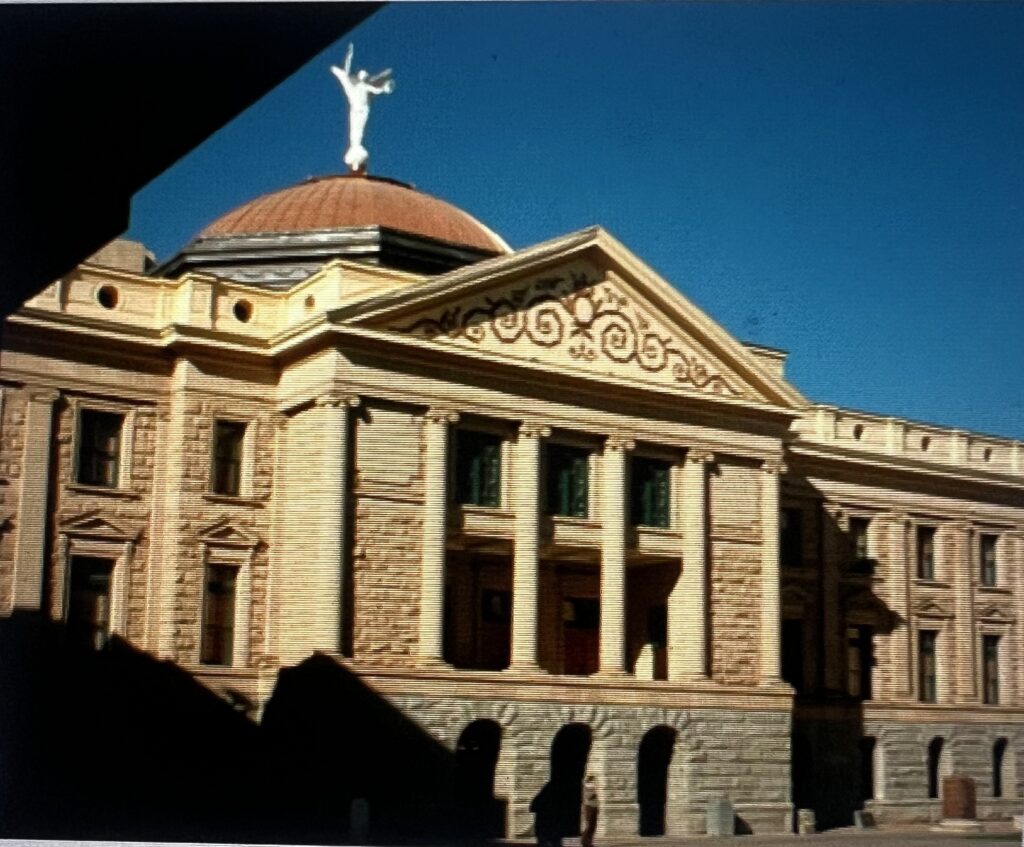
The move to use more than $70 million from the Long Term Water Augmentation Fund was called shortsighted by a representative of the state agency charged with using the money to bring new water to the state.
And several lawmakers on the Senate Appropriations Committee — which overwhelmingly voted Tuesday to advance the package of bills making up the $17.6 billion budget for the coming year — criticized the so-called “sweep’’ of money from the dedicated fund.
“It’s not even a sweep. It’s worse than that,’’ complained Sen. Vince Leach, a Tucson Republican. “It’s a piggy bank. And we’re using it, and have been using it, as a piggy bank. And this budget continues the piggy bank approach.’’
The vote in the Appropriations Committee sets the stage for the full Senate to consider and vote on the budget on Wednesday.
The entire package was negotiated between Democratic Gov. Katie Hobbs and Senate Republicans. House Republicans passed their own spending plan last week for the budget year that starts July 1, but Democrats and Hobbs pronounced it dead and are instead embracing the Senate deal.
All of the 16 bills in the budget plan passed with a supermajority of the 10 committee members in support. So did bills waiving a spending limit on K-12 schools for the coming two years, which removes the chance they could be blocked from spending some of the money the Legislature appropriates.
Several other items in the plan drew some opposition from lobbyists who are pushing for specific changes.
For instance, state corrections officers want a 20% raise instead of the 5% boost Hobbs and lawmakers put into the budget. Their lobbyist warned that a wave of hundreds of retirements could hit already understaffed prisons if lawmakers don’t reward guards with better pay.
And hospital officials who went along last year with a temporary two-year, $100 million a year tax to help fund the state’s Medicaid plan hoped to see it end early.
But Tom Farley, lobbyist for the Health System Alliance of Arizona, conceded the major hospital groups in the alliance were happy the Senate plan didn’t echo the House budget, which made the increased assessment permanent.
“We appreciate the fact that the Senate budget, unlike the House budget, ends this practice this year,” Farley told the committee.
“So we’re the lesser of two evils in your eye?’’ Sen. John Kavanagh, R-Fountain Hills, asked Farley.
The hours-long hearing was the public’s only chance to comment on the budget deal. And it featured a rare lack of criticism of a budget deal.
In fact, several lobbyists and members of the public praised the budget for the funding it did provide, including two women whose children are developmentally disabled and rely on state aid for care. A state funding shortfall earlier this year required supplemental funding to get the program through the end of the budget year and the agreed-upon budget fully funds the Division of Developmental Disabilities for the coming year.
Rachel Lack, whose 13-year-old son Henry is non-verbal and has severe autism, said state money helped her obtain an iPad with a touch chat app that, for the first time, allowed him to communicate.
“This device he got through DDD and we’re so appreciative that he has his voice,’’ Lack told the committee, calling it “life-changing.’’
“For the first time, he could tell us what he wanted to eat,’’ she said. “This budget will help more children like Henry receive (similar) devices. Every person deserves to have a voice.”
But there was the criticism of sweeping $73.2 million from the augmentation fund for the Water Infrastructure Finance Authority (WIFA).
The 2022 legislation set aside $333 million a year in three successive years so the authority would have $1 billion dedicated to finding and developing new water sources, mainly from outside of the state. Then-Gov. Ducey, a Republican, was intent on having the state develop a water desalination plant on the Gulf of Cortez in Mexico and pipe the water to Arizona.
That plan fell apart, at least in part because of the secrecy surrounding it and in part because the Mexican government said it never was consulted.
That has left the WIFA fund expecting money that lawmakers have instead decided to use for something else. That includes $30 million for wildland firefighting, $2 million to clean up the Iron King Mine in Humboldt, and $1.7 million for litigation the state may pursue to protect its Colorado River water supply.

The Legislature made the first $333 million payment into the fund in the budget passed in 2022, but has never met its commitment since. In 2023, lawmakers put in only $190 million, and last year cut the planned appropriation to zero and “swept’’ $100 million from the account to help balance the budget.
“Repeating that mistake now sends a deeply contradictory message, not only to Arizonans but to cities, utilities and private partners we rely on to move serious projects forward,’’ said Judah Waxelbaum, WIFA’s chief legislative liaison.
Tuesday’s vote occurred despite the fact that earlier this year, the House and Senate overwhelmingly passed a resolution calling those earlier raids on the fund a mistake and vowing to restore funding that is “critical to Arizona’s current and future economic and environmental health.’’
4. Upper Agua Fria Watershed Program Meeting Minutes. UAFWP Vision Statement: As prudent stewards of the Upper Agua Fria Watershed – which provides beauty, bounty and sustenance – we envision a sustainable multi-generational future of health and continued abundance achieved through best-practice management of this semi-arid watershed’s natural systems.
UAFWP Mission Statement: The Upper Agua Fria Watershed Partnership provides a regular forum to engage diverse stakeholders proactively to develop, discuss and coordinate:
Relevant objective information, Collaborative work projects, and Best Management policies concerning holistic, long term health of the watershed’s natural systems in the context of demographic and ecological change.
UAFWP June 3, 2025 Notes:
a.Introductions and Announcements: Henry Dahlberg, Mingus Springs, U of A James 4H Camp; Bill Fathauer, Arizona Metals – Kay Mine; Russ Pilcher, Prescott, Sierra Club Exec Board, CWAG, Upper Verde Water Sentinel – monthly flow trending down, AF Wet/Dry mapping; Paul Glaves, CWAG, Prescott Audubon; Ben Serpa, Yavapai County Flood Control; Mary Hoadley– Chair; Treasurer, FAFNM; and BCHP Board Member.
Helen and David Hamernick in Minnesota, Tom Thurman in Florida at Theme Parks, Greg Watts, jeep died at Cordes Junction; Supervisor Jenkins, concerned about state of the road after rain. Laney Meeker, ADWR, understaffed.
b. Thanks Henry for hosting! Headwaters having some thinning. Trees with orange ribbons marked along entry will be saved; marked by NRCS. Project of FS and AZ State Forestry and Fire to thin on private land. 7/8 landowners participating; NRCS pays for 3, AZFF for 4 properties. Blue flags mean difficult cut; logging to start in September, 2 months, 50 to 75 truckloads of trees removed to improve fire health and water production. HD hopes logs not to be used for firewood. Chino has pallets facility; owners pay $2400/acre; 170 acres involved, some have never been thinned; 2024, 1000 acre burn one mile away, used camp pond water. HD happy trees are flagged, not painted, butt mark at trunk base to indicate if tree wrongly cut. Always working on ‘gabions’ for erosion control; 18” annual rainfall. Some of logs will be used for beaver dam analog structures. Below Camp, 4 years of cattle exclosure on 800 acres; nice vegetation rebound. Wet/Dry down first 2 miles, drier trend. Chad Yokum at FS helps with data. 10 miles down to 169. Ben Serpa BS: $2400 an acre? cost to logger $2150, then $200 to deal with wood residue. Camp hosts Man against Horse Race; Camp has 55 acres, Henry’s Ranch 35. Camp available for many uses; currently boys gymnastics camp, last week 120 girl gymnasts. BS: flood control looking for a retreat location. 96 solar panels at Pavilion roof supplies all power. Henry and his wife were working on the Navajo Reservation 1967 – 8, wanted to start a school and heard about the property, $75k for 100 acres; 1899 buildings; decided on camp instead of school. James family helped acquire Camp for U of A 4H, gave $50k for 5 years. facilitated lots camp improvements. Current Director Margaret Carroll has brought in more than $1million in grants.
c. Development Updates: Long Road Energy (www.longroadenergy.com/agua-fria; aguafria@longroadenergy.com; 833-367-7889). BS: EVS, Longroad Engineers, moving forward with design with Yavapai County; waiting for Flood Control feedback on retention basin designs; first flush detention requirements; considering tile drains, sand infiltration devices. Geotech analysis shows poor drainage and infiltration; 36 hour drain time requirement; distributed detention possible, full Stormwater plan not yet submitted. BS thinks Longroad engineers need pre-code meeting with all departments. Drainage Manual review grant on hold, 75%/25% reimbursement, possible sweeping changes; more LID (Low Impact Development); last update 2025. GSI (Green Stormwater Infrastructure); BAD (Best Available Data). Cordes Junction TA: Project facing new issues. Love’s exploring possible underground stormwater storage under parking lots with large perforated pipes. Orme School closed, but may have a buyer by July. Chauncey Ranch sold to David Bateman who owns Halle Ranch; 6000 acres. Doing a lot of construction, underground mushroom farm, possible dairy (200 cows make a CAFO (Centralized Animal Feeding Operation); blading some state land for tiny subdivision, claiming agricultural exemption from State. Agua Fria not impaired through the ranch; if impaired would have to sample.Condos planned for Bench Ranch on Big Bug Creek. Lakeshore 650: Amazon Fulfillment Center next to Fairgrounds. Paul Glaves PG: CWAG (Citizen’s Water Advisory Group) (has great monthly newsletter with relevant meetings) pushing Lakeshore 650 builders to consider water neutral development ( Gary Beverly willing to address our group on this concept). no landscape watering; encourage groundwater recharge. Prescott Valley not interested in LID.
d. Black Canyon City Water Issues:ADOT: <improvingi17.com>, 877-476-1717. Progress! Hydroseeding along I 17 includes native seeds, fertilizer, mulch; no herbicides or pesticides; for bank stabilization and erosion control. Arizona Metals, Kay Mine: Hotline: 623-252-2291; <kayexploration.com> Chris Steuer CS: 2 rigs continuing to work. Well level data .67 to .82 ft down end of May. Silvercord: no update. Rock Springs RV Park: huge, 400 spaces, any new wells may affect Rock Springs. Phil Gutierrez was supposed to join May meeting to discuss water and wastewater plans. No show. MH trying to reach owner to learn water and wastewater plans as well as YC Development Services to access their application. Should need an ADEQ General permit for septic. Greg Watts complained to County about Stormwater, trucks tracking materials off site. Maybe issues with ADOT and their right of way. BCCWID well levels are 31 to 34.6 feet. New well dug only delivering 10 gpm; looking to draw from higher up the casing.
f. FAFNM:Damon Haan DH, Tim FloodTF: May 31, 2025, BioBlitz, last BioBlitz, 2016, 24 participants. AFNM Bio Blitz- 24-hr period from May 31st – June 1st. https://www.inaturalist.org/projects/2025-agua-fria-national-monument-bio-blitz. 30 participants identified 525 different species.Tim Flood working on Wet/Dry. Possible Bruce Babbitt Talk in September. June 9 talk at Sun City Library attracted 40+.
g. Wildlife Connectivity: Tim Flood letter drafted with CAWA sent to AZGFD Commission to demand wildlife connectivity throughout Central Yavapai, protect corridor from Verde headwaters through Prescott Valley across I 17 to Reimer Flat and Perry Mesa. AZGFD still allows pronghorn hunting, also on south and east sides of Fain road. Next Commission Meeting June 13, 2025. Barbara Jacobsen will be reading in the letter or excerpts at the Flagstaff Office.
h. Other: 2011 Isotope study done by Kristine Uhlmann at U of A. 3 samples, Orme water greater than 2000 years old; Cordes Lakes, greater than 65 years old, Black Canyon City, less than 65 years old. Paul Glaves PG: Gary Beverly says Prescott Valley ground water 10,000+ years old. Some wells going dry with groundwater levels dropping. Biggest risk is to be off municipal water. Deepening wells very expensive. Williamson Valley said had 100 year supply, but residents used a lot of water, 8000 acft a month. Now wells going dry, many hauling water. Paul collects rainwater, 1500 gals storage, never runs out, uses only for landscaping. Mary Hoadley MH: ADWR Supply Demand studies not very informative about ground water in PAMA or Upper Agua Fria basin (2024 studies).
BS: Northern Arizona MS4 Collaborative. Tracy Lund., Prescott Valley Water Resource Manager. Has ideas for stormwater reuse, rewater Agua Fria from Glassford Hill to Highway 69. We should invite her to a meeting. No ADEQ TMDL update yet. NRCS: Xavier left. Project on Granite Creek. Management Plan, for flood reduction, relation to Verde; State Trust Land for recharge?
Rus Pilcher RP: went on very informative Walt Andersen led Naturalist Retreat, 3 different field trips. Gary Beverly GB: flow at Perkinsville Bridge 8.8 cuft/sec; Bear Siding 11.3 cuft/sec. PG: Big Chino Pipeline Discussions; significant reduction in H20, from Paulden to Perkinsville Bridge 95% reduction in fish.
i. Protect AZ Waters: info @azcrosswatershed.net, May 28, 2025, AZ Water Resilience Toolkit Lunch and Learn, Susan Craig ASU (susan.craig@asu.edu) ASU AZ Water Initiative; Check out AZ Water Blueprint. AZXWSN in person meeting at TNC in Phoenix, July 15, 11 – 3.
Next Meeting: July 1, 2025 on line.
Copyright 2025 @ EnviroInsight.org
