
Daniel Salzler No. 1359
EnviroInsight.org Five Items May 22, 2026
—————Feel Free To Pass This Along To Others——————
If your watershed is doing something you would like others to know about, or you know
of something others can benefit from, let me know and I will place it in this Information .
If you want to be removed from the distribution list, please let me know.
Please note that all meetings listed are open.
Enhance your viewing by downloading the pdf file to view photos, etc.
The attached is all about improving life in the watershed through knowledge.
If you want to be removed from the distribution list,
please let me know. Please note that all meetings listed are open.
Check our website atEnviroInsight.org
1. USIBWC Highlights Wastewater And Border Infrastructure Progress Under Commissioner McIntosh. The agency made notable progress in border water management, including a binational agreement (Minute 333) with Mexico, innovative odor reduction pilot projects, and efforts to modernize aging infrastructure.
The U.S. Section of the International Boundary and Water Commission marked one year under Commissioner Chad McIntosh, P.E.,highlighting progress on wastewater treatment expansion, cross-border sewage mitigation and water infrastructure projects along the U.S.-Mexico border.
Among the agency’s major milestones was a rapid expansion of the South Bay International Wastewater Treatment Plant, where crews added 10 million gallons per day of treatment capacity in 100 days — a 40% increase intended to reduce untreated sewage flows impacting the Tijuana River Valley and nearby coastal communities.
“USIBWC exists to protect people, property, and water resources along the U.S.-Mexico border,” said Chad McIntosh, commissioner of the U.S. Section of the International Boundary and Water Commission, in a press release. “Over the past year, our staff have moved quickly to strengthen wastewater treatment, secure fair water deliveries for U.S. farmers and communities, and reduce flood risks in both countries.”
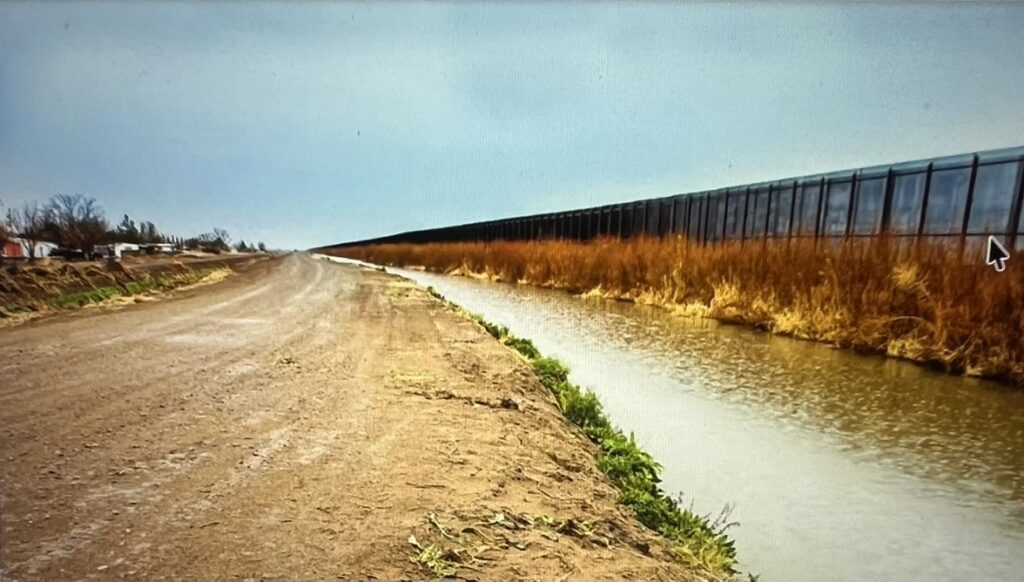
The agency also reported progress on design work to further expand the plant to 50 mgd, with design completion expected later this year. In addition, the commission signed Minute 333, a binational agreement requiring Mexico to build and maintain new sanitation infrastructure in Tijuana while adopting wastewater and stormwater management practices aligned with U.S. standards.
Other initiatives highlighted by USIBWC included a pilot project using ozone nanobubble technology to reduce bacteria and odors in portions of the Tijuana River and coordination with federal agencies on border water and flood control projects.
“None of this work happens without the dedication of USIBWC engineers, operators, scientists, and field staff,” McIntosh said in a press release. “Over the next year, we will keep pressing forward on the Tijuana River sewage crisis, modernizing our aging infrastructure, and making sure the treaties we administer continue to protect public health and environmental quality for future generations.” Soure: Wastewater.com
2. The Colorado River Is on the Brink of Disaster Years of drought and political brinkmanship have pushed the waterway to the breaking point.
The Colorado River is running dangerously low, and the seven Western states that rely on it can’t agree on how to share what’s left.
A deal deadline came and went in February, leading the federal government to threaten its own solution—one that would keep the dams generating power, but likely bring painful cuts to water use. “We’re positive about one thing—no one will be satisfied,” Interior Secretary Doug Burgum said last month.
The river provides water for 40 million people and more than 5 million acres of farmland. Its dams produce electricity for millions of people.
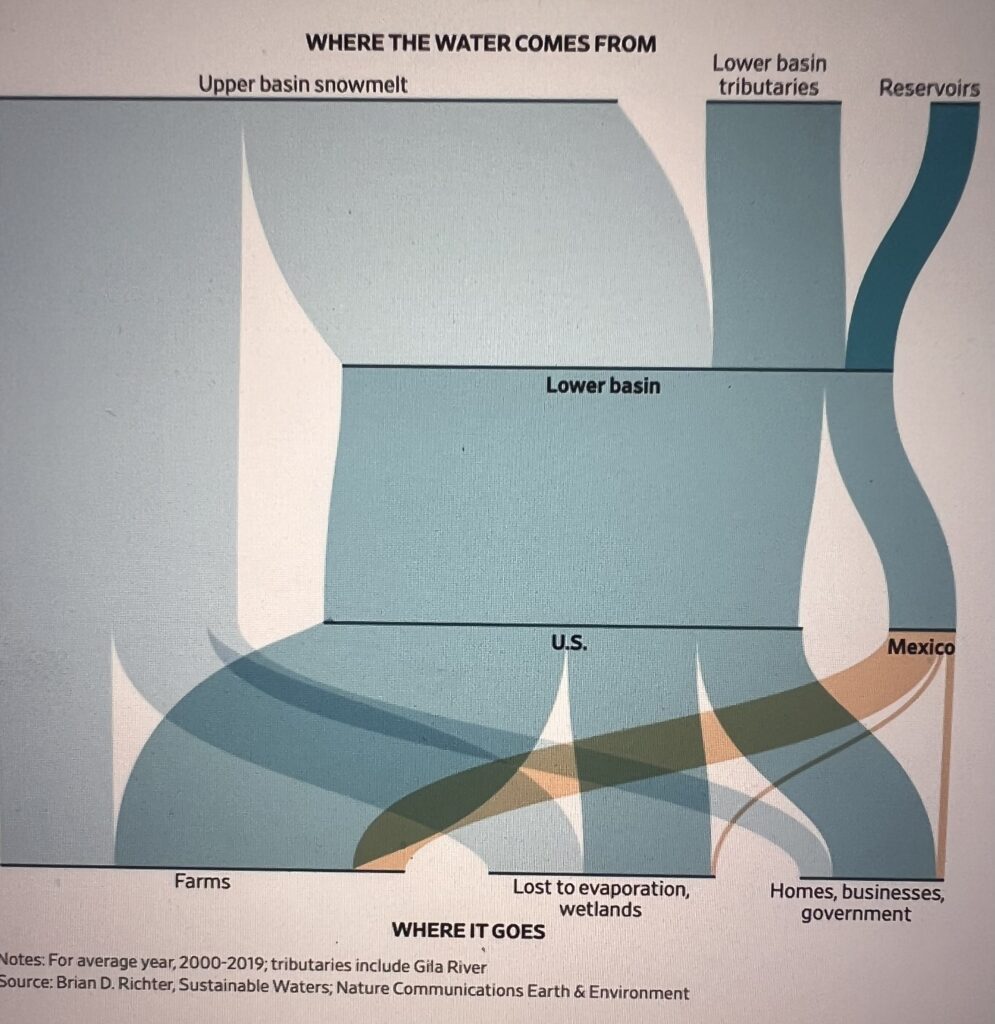
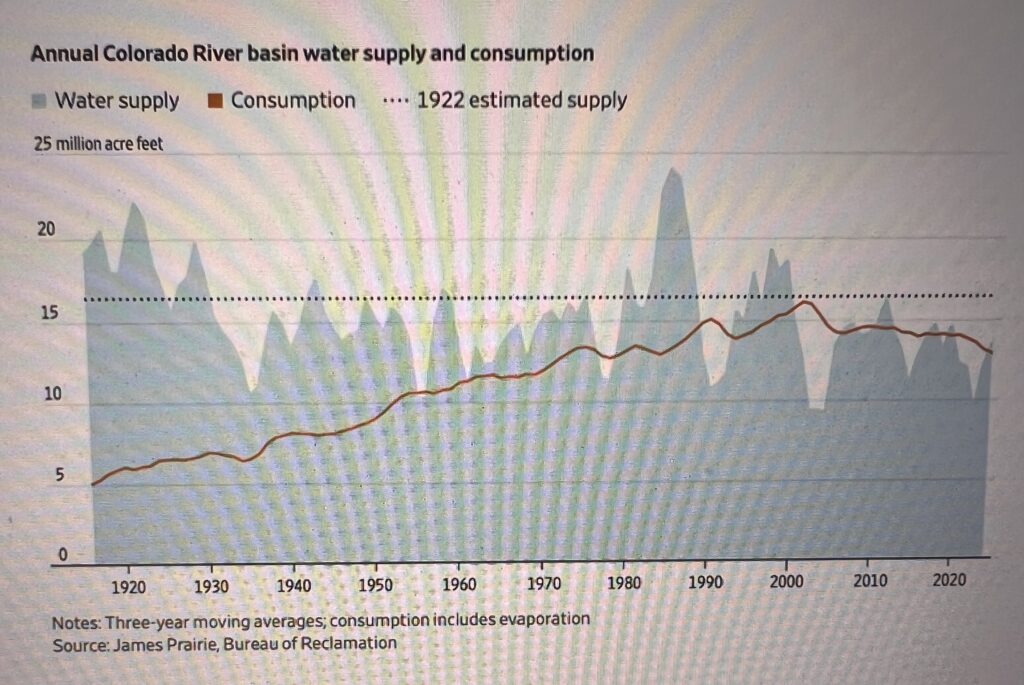
The current crisis is rooted in a compact Western states made in 1922. Officials overestimated how much water the river would provide. By the 21st century, as drought gripped the region, it became harder to meet the deal’s water-allocation obligations. The diminished water supply, coupled with a growing population, has led to years of shortfalls.
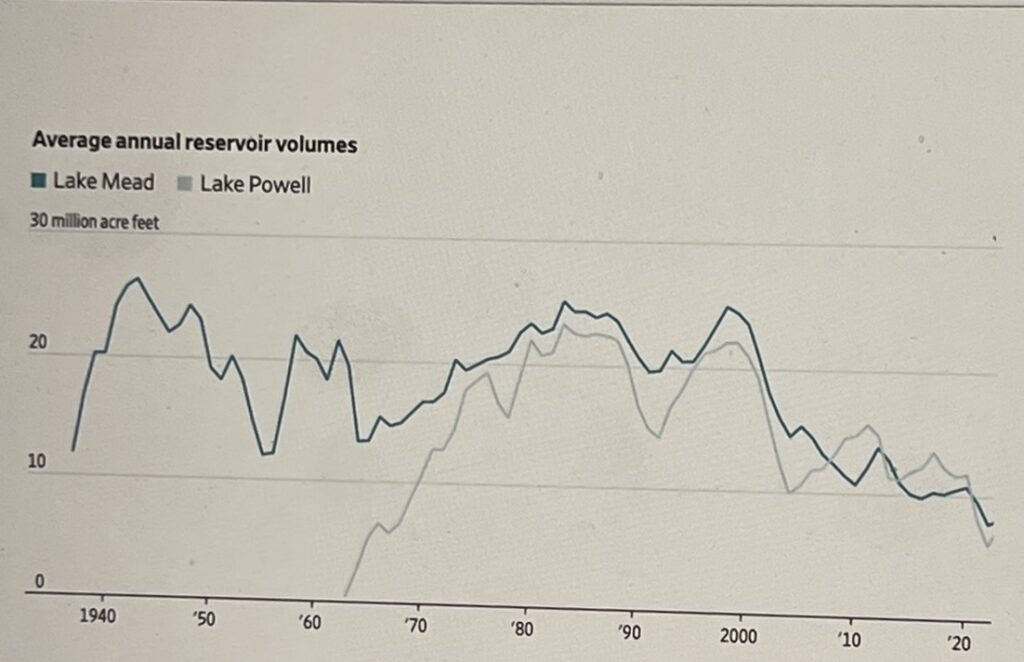
To make up for shortfalls, states pull water from the reservoirs, which serve as storage banks for the system. Drawing down reserves has taken a toll. Lakes Mead and Powell, the biggest reservoirs in the basin, have fallen about 75% from peak volumes.
The water shortages have inflamed tensions between the upper basin states: Colorado, Utah, Wyoming and New Mexico, and the lower basin states: Arizona, California and Nevada. The 1922 agreement granted roughly equal allotments from the river. But the lower basin routinely uses more.
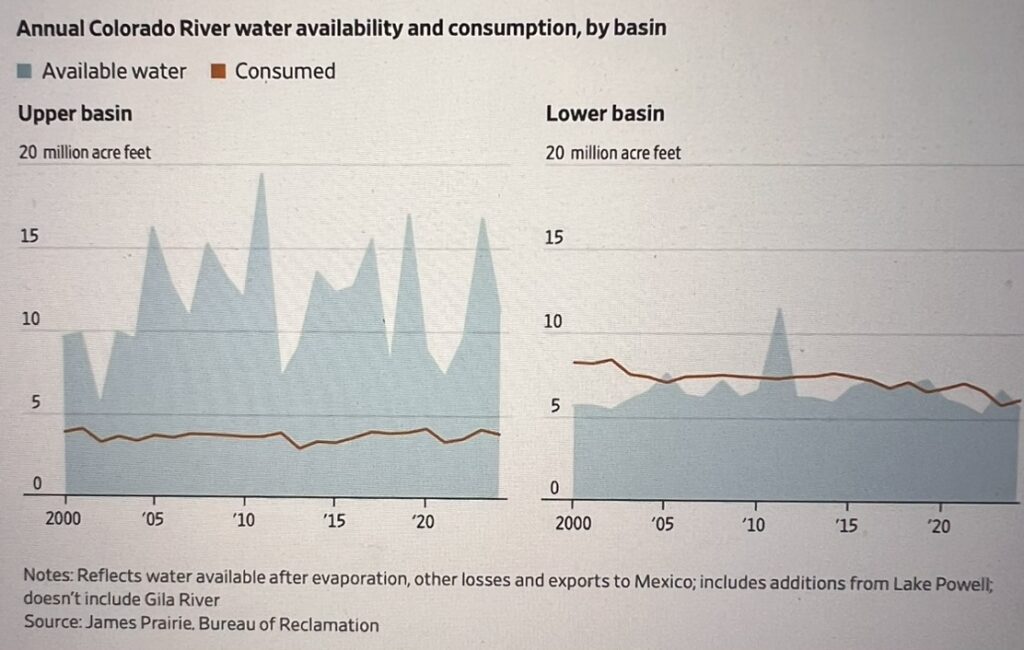
The upper and lower basins are jockeying to shape a new, long-term solution, as several water-sharing pacts expire this year.
The unusually warm winter led to this being the worst year for snowpack in Colorado and Utah on record, according to monitoring agencies. Officials estimate Lake Powell will receive the least amount of water this year since the reservoir began to fill in 1963. “So really, just no good news,” said hydrologist Cody Moser of Colorado Basin River Forecast Center.
For now, authorities are sending water from an upstream reservoir to replenish Lake Powell, but it is a short-term fix. “There’s not enough water to fill the hole,” said Brian Richter, president of Sustainable Waters, a global water-education organization.
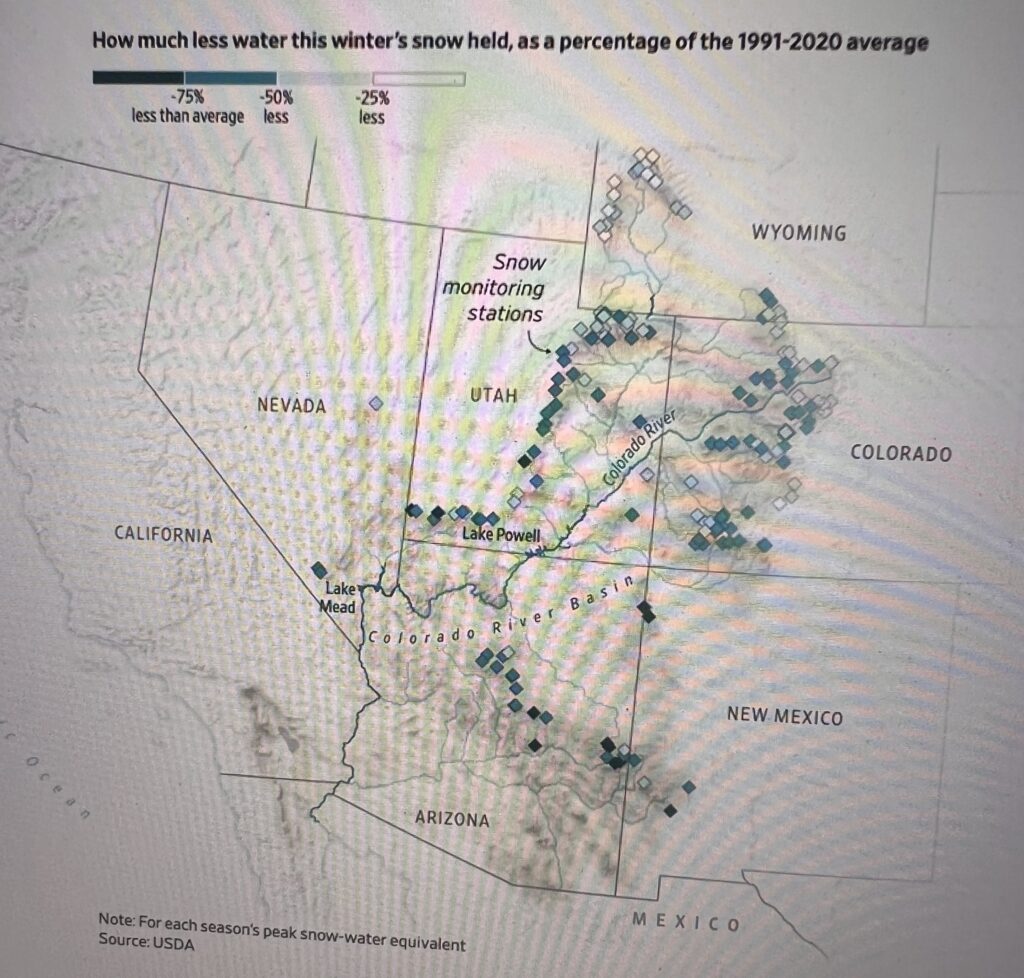
Top map is a composite of satellite images from Landsat taken March through September, 2020 to 2026; Lincoln Institute of Land Policy (canals, rivers)
Copyright ©2026 Dow Jones & Company, Inc. All Rights Reserved. Appeared in the May 16, 2026, print edition Wall Street Journal. To read entire article,go to https://www.wsj.com/us-news/climate-environment/the-colorado-river-is-on-the-brink-of-disaster-628516be
3. What Country Has The Most Fresh Water?
a. Canada
b. Brazil
c. Russia
d. USA
e. Greenland
Answer found at end of Newsletter
4. Arizona Drought Declarations Remain In Place.
After 30 years of drought, hydrologists say the Hoover Dam will lose 80% of hydropower production by spring 2027.
PHOENIX (CN) — Arizona climate experts recommended Thursday that Governor Katie Hobbs renew a drought declaration in effect since 1999 as the state continues to reel from the hottest March on record.
Though a strong El Niño is likely to form over the Pacific this summer, which could bring tropical rains to the Four Corners region, members of the governor’s Drought Interagency Coordinating Group aren’t betting on it saving the day.
“This is not going to be pretty,” said Jordy Fuentes, executive director of the Arizona Power Authority.
As the Southwest drought enters its fourth decade, the state’s two largest reservoirs along the Colorado River continue to inch toward deadpool, at which the Hoover and Glen Canyon dams won’t hold enough water to generate hydropower that is in turn used to pump Colorado River water across the state.
“We’ve backed ourselves in a corner and have mostly used all the tools in our toolbox,” Fuentes said. “We have very little tools left except to cut.”
The Arizona Department of Water Resources met Wednesday to discuss the most recent conservation proposal from the lower basin states (Arizona, California and Nevada) that would save up to 3.2 million acre-feet of water over two years, but Fuentes said that likely still won’t be enough.
Regardless of how much is cut, most models predict that Lake Mead, currently at 31% capacity, will drop to 1,035 feet elevation by spring 2027. When that happens, the Hoover Dam’s hydropower output will drop from 2,030 megawatts to just 382 megawatts.
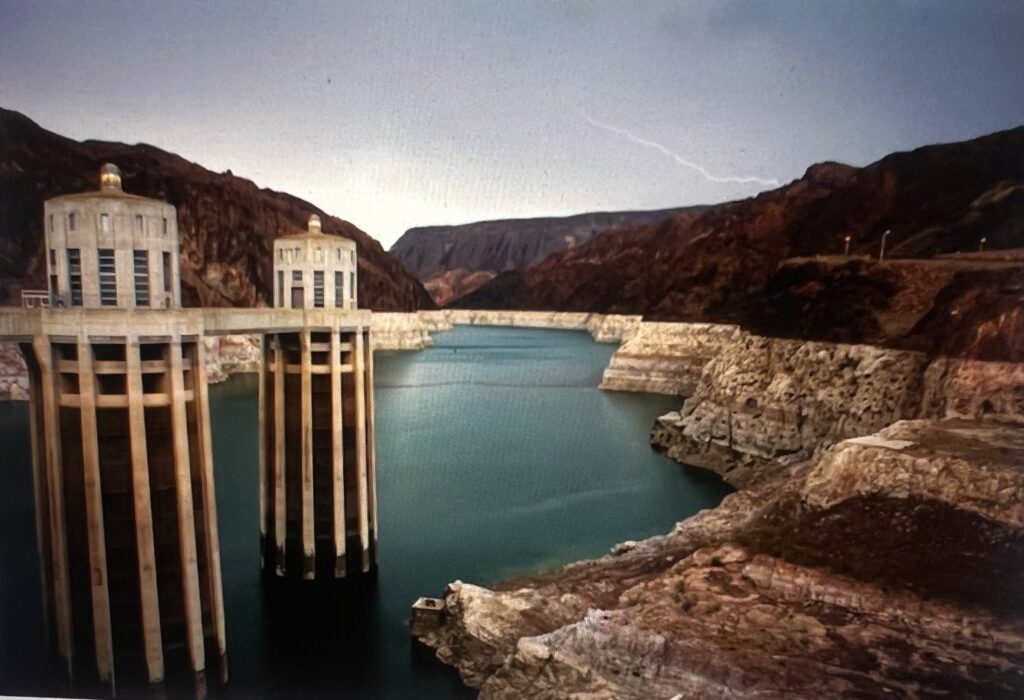
“At the end of the day, you might be able to save a month or two,” Fuentes said. “But ultimately, it’s gonna drop below 1035 because there just isn’t enough water.”
At 895 feet, the dam would be unable to produce any power.
At the other end of the Grand Canyon, Lake Powell sits at 24% capacity, just 150 feet above deadpool.
On the Salt and Verde River watersheds, which provide Phoenix with about 60% of its water, the situation is not much better.
Since last year, the overall system has dropped from 76% to 53% capacity, thanks largely to one of the driest winters on record in the Grand Canyon State.
State Climatologist Erinanne Saffell said the outlook going into 2026 was optimistic. In 2025, Arizona recorded its ninth wettest fall and Maricopa County’s wettest on record.
“Then we entered into the hottest December on record for Arizona,” Saffell said.
Some snow fell in November and again in late February, but none was enough to accumulate runoff into the aquifers. Any snowpack that accumulated was quickly killed by a record-breaking March.
“Even though we had some mitigation from our very wet fall, we’re starting to see that (drought) expansion again,” Saffell said.
National Weather Service meteorologist Mark O’Malley said temperatures will continue to rise in another above-average temperature summer. In the last 50 years, average summer temperatures have steadily risen by 0.7 degrees Fahrenheit every decade. The coolest summers of the last 10 years would have been the hottest summers of the 1970s.
“I would not expect that this trend is going to change,” he said.
If a strong El Niño creates warm waters in the Pacific Ocean, he said that could create more tropical storms, which would dump rainwater over the Southwest. He said there’s currently a 65% chance of a strong El Niño, but that doesn’t mean a 65% chance of heavy rain for Arizona.
Historically there is no reliable pattern for El Niños. Some carried heavy rains while others didn’t affect the state at all.
In Northern Arizona, wildfires are already raging about a month ahead of schedule. Little to no snowpack, drought-stressed trees and a lot of dead pinyon and juniper mean a higher risk this year of crown fires, in which fire climbs to the tops of trees and quickly spreads across the canopy. So far this year, 296 fires have burned nearly 6,000 acres of forest, reported Tiffany Davila, public affairs officer for the Arizona Department of Forestry and Fire Management.
Both the 1999 declaration and a later drought declaration enacted in 2007 by then-Governor Janet Napolitano will remain in effect for the foreseeable future. Hobbs last renewed the declarations in 2024.
The coordinating group will meet again in November, having learned whether the El Niño brought favor to the Copper State.c Source: Courthouse News Service, https://www.courthousenews.com/arizona-drought-declarations-remain-in-place/\
5. Final Oak Creek Cleanup Before Summer. Join us for one more cleanup in the heat of Sedona before the summer heat arrives!
Date:Thursday, May 28, 2026
Time: 8:30 AM – 10:30 AM
Location: Sunset Park, Sedona
Volunteer Tasks include:
Removing litter from Sunset Creek and the surrounding area, which drains directly into Oak Creek.
Note: Please wear sun protection and bring plenty of water.
We’ll provide snacks, all necessary cleanup materials, and lots of gratitude for your time and energy. Volunteers should come prepared with:
💧 Water
🥾 Closed-toe shoes
☀️ Sun protection
Questions? Click here for more information and to register to join.
Let’s make a difference together for our community and for Oak Creek—your participation helps protect and preserve this precious watershed! We can’t wait to see you there!
REGISTER AT : https://volunteersedona.jotform.com/261334013955958
Answer To Number 3 Above: Brazil, found in South America, has by far the most fresh water out of any country in the world. In a measure of total renewable water resources, Brazil blows away the competition with a total of 8.233 cubic kilometers ( about 12% of the worlds total fresh water) of water. In second came Canada, with under half of Brazil’s fresh water at 4,100 cubic kilometers cubed.
Copyright 2026 EnviroInsight.org
