
Daniel Salzler No. 1370 EnviroInsight.org Three Items August 7 2026
—————Feel Free To Pass This Along To Others——————
If your watershed is doing something you would like others to know about, or you know
of something others can benefit from, let me know and I will place it in this Information .
If you want to be removed from the distribution list, please let me know.
Please note that all meetings listed are open.
Enhance your viewing by downloading the pdf file to view photos, etc.
The attached is all about improving life in the watershed through knowledge.
If you want to be removed from the distribution list,
please let me know. Please note that all meetings listed are open.
Check our website atEnviroInsight.org
- Arizona, California And Nevada Would Share Cuts Under Federal Proposal To Manage The Colorado River. Three western U.S. states would take less water from the Colorado River under a federal proposal released last Friday to stave off a crisis in the beleaguered waterway.
The U.S. Bureau of Reclamation proposal spares four other states from facing mandatory cuts for now. It’s meant to be flexible, allowing deeper cuts in drier times while giving the states more time to collectively agree on how to manage the dwindling resource that flows through dams to produce hydropower.
The Lower Basin states of Arizona, California and Nevada could together be forced to reduce their use by up to 3 million acre-feet (130 billion cubic feet) annually through 2036 — about the amount that Arizona and Nevada receive and enough to serve more than 25 million people a year. The actual reductions would be determined every two years based on conditions throughout the basin.
“The Department has a responsibility to ensure the Colorado River system remains reliable and resilient for the millions of Americans, communities and industries that depend on it,” Interior Secretary Doug Burgum said in a statement.
Under the proposal, California, Nevada and Arizona would divide half the cuts based on a plan they already developed. Beyond that, priority water rights come into play. The priority system generally benefits California users over those in the other states.
Arizona and Nevada have faced mandatory reductions before, but the proposal outlines deeper cuts that could impact agriculture, cities and tribes. It could translate into higher water prices, more reliance on groundwater and leaving fields unplanted, experts say.
The proposal comes after years of deadlocked negotiations among the states and threats of lawsuits if a proposal didn’t comply with longstanding laws and guidelines that govern the river, some of which expire at the end of 2026. A record-dry winter also left two key Colorado River reservoirs at a combined record low. Federal officials are expected to finalize the proposal in the coming days.
More than 40 million people in seven U.S. states, several tribal nations and Mexico rely on the flows of the 1,450-mile (2,334-kilometer) river. Decades of overuse, along with rising temperatures, drought and climate change, mean it no longer provides what was promised in 1922.
The river’s health often is determined by how much water is in Lake Mead and Lake Powell, the two largest human-made reservoirs in the U.S. Together, the reservoirs are at their lowest point since they began filling, according to a recent paper by Colorado River experts, and approaching levels where they could no longer produce hydropower.
How the water is allocated and conserved — especially amid a decades-long drought — has led to contentious arguments among the states, including threats of lawsuits. Both basins drew up proposals but didn’t decide together on a single plan.
Because the states didn’t reach an agreement, the federal government stepped in with its own proposal to buoy the river.
How are the states reacting?
Leaders in Arizona, which has the lowest priority rights in the Lower Basin, called the federal proposal flawed. Those in California said it’s an important milestone but not the finish line. Nevada officials called the proposed reductions unrealistic and devastating.
The Lower Basin states have been united in wanting all seven states to share in specific, measurable cuts. The Upper Basin states of Colorado, New Mexico, Utah and Wyoming, meanwhile, repeatedly pushed back, saying mandatory cuts to their water use would be illegal under the existing compact for the Colorado River. While the federal proposal mandates cuts in the Lower Basin, the Upper Basin states can proceed with voluntary water cuts primarily among agricultural users.
The four Upper Basin state governors gave the document a favorable initial assessment but said they were still reviewing it.
“We are encouraged that new operating guidelines will better reflect existing water supply which must underpin any practicable plan going forward,” the governors said in a joint statement.
The Arizona Department of Water Resources said the proposed cuts devastate its water users and economy. The Central Arizona Project, which manages much of the state’s allocation used primarily in metro Phoenix and Tucson, said the proposal doesn’t accurately portray Arizona’s rights.
What impact could the plan have?
The states will have a say in how they shoulder the cuts, though the federal government is expected to offer suggestions in the coming days.
Arizona Department of Water Resources director Tom Buschatzke said it will be painful. Farmers in Southern California and Yuma, Arizona, produce the majority of North America’s leafy greens in the winter.
“Those are a lot of potential devastating impacts — and a lot of uncertainties for all of us,” Buschatzke said.
Cities in metro Phoenix don’t rely entirely on the Colorado River and likely will keep everyone’s taps running, but water rates will increase in some areas, said Rhett Larson, a water law professor at Arizona State University. The city of Gilbert, for example, has increased residential water rates by 50% since April 2025, he said.
“We are not running out of water. We’re running out of cheap water,” Larson said.
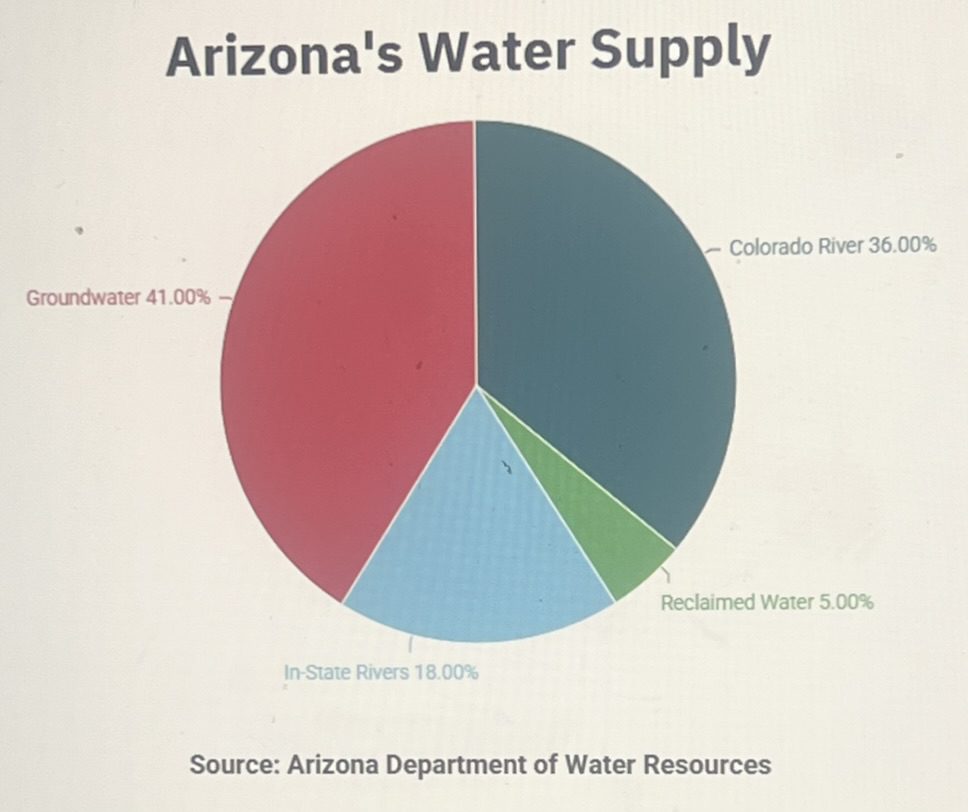
Meanwhile, cities across the Colorado River basin are constantly on the hunt for new sources of water, like tapping groundwater, treating wastewater and desalinating water, all of which are more expensive than deliveries from the Colorado River. ___ Pineda reported from Los Angeles and Peterson from Denver. Associated Press writer Mead Gruver contributed from Fort Collins, Colorado. Source: Associated Press July 31, 2026.
2. Arizona Water Conservation Efforts Paying Off. At first glance, Arizona’s booming population and decades-long drought might seem like a recipe for soaring water demand. Instead, many cities across the state are telling a different story.
From Tucson to Phoenix, residents are using significantly less water per person than they did a generation ago. Cities credit everything from replacing thirsty grass lawns with desert landscaping to installing more efficient plumbing fixtures and encouraging conservation through rebate programs.
The result is a surprising trend: Arizona has added hundreds of thousands of residents while many communities have reduced the amount of water each person uses every day.
Cities cutting down usage
In Tucson, the average resident used about 121 gallons of water a day in 1996. Today, that number is about 74 to 76 gallons, according to Tucson Water’s FY 2023-24 Water Conservation Program Report, which attributes the decline to tiered water rates, conservation education and rebate programs.
Phoenix has experienced a similar shift. According to the City of Phoenix Water Services Department, total residential water demand has fallen by about 12.5% despite substantial population growth, while per-capita residential water use has declined by roughly 29% since 1990.
City officials credit more efficient plumbing fixtures, appliance upgrades and the replacement of grass lawns with drought-tolerant landscaping.
Across the Valley, water conservation has become part of everyday life.
In Glendale, city officials reported a 19% reduction in municipal water use during a Stage 1 Drought Watch, far surpassing the city’s initial 5% conservation goal.
Much of the savings came from replacing nonfunctional turf with xeriscape landscaping and expanding water-efficiency efforts. The city also continues to offer rebates to encourage residents and businesses to convert grass landscapes to low-water-use designs.
Other cities are preparing for an uncertain water future as well.
Scottsdale, which receives roughly 70% of its water from the Colorado River, remains under the first stage of its drought response plan and is asking residents and businesses to voluntarily reduce water use by 5%. The city also offers rebates for grass removal, smart irrigation controllers and other water-saving improvements.
New standards
Cities are also paying closer attention to large commercial water users.
Municipalities including Phoenix, Mesa, Chandler, Avondale and Marana have adopted or proposed policies limiting water consumption by industrial facilities and data centers. Chandler has established water-use standards for new data centers, while Marana prohibits the use of potable water for data-center cooling, reflecting a broader effort to balance economic development with long-term water security.
Homeowners are also being encouraged to do their part. Across metro Phoenix, cities offer financial incentives for replacing traditional grass lawns with drought-tolerant landscaping. Depending on the community, rebates range from hundreds of dollars to as much as $5,000 for qualifying landscape conversions.
While Arizona’s water challenges are far from over, cities are showing that population growth does not necessarily have to mean higher water consumption. Instead, officials say, long-term planning, infrastructure improvements and public participation are helping Arizona stretch every drop. Source: Peoria Independent July 28, 2026.
3 .With High Temperatures And Low Moisture, Many Insects Are Finding Their Way Inside Your Home. One Of Them May Be Daddy Longlegs.
They may look like spiders, but Daddy Longlegs belong to a different group of arachnids entirely.

Harvestman, more commonly known as Daddy Longlegs, stands on a leaf. While they are arachnids, Daddy Longlegs have a single, oval-shaped body, compared to spiders who have two distinct body segments.
There’s a pretty pervasive myth that goes something like this: “Daddy Longlegs are the most venomous spider in the world, but their fangs are too small to pierce human skin.”
Are Daddy Longlegs spiders?
Daddy Longlegs are arachnids that have tiny, pill-shaped torsos and legs that go on for days. They have a pair of shoddy eyes, breathing tubes known as trachea, guts for digesting, and even secret, trap-door genitals, but really, for the most part, these animals are just an absolute mess of legs and the chunky thing those legs connect to, like bicycle spokes to a hub.
Despite their appearance, Daddy Longlegs are not spiders at all. Like mites, ticks, and scorpions, Daddy Longlegs are spider cousins. Which is to say, Daddy Longlegs are arachnids that belong to the order Opiliones, not Araneae (where the spiders are classified).
Furthermore, spiders usually have eight eyes, while Daddy Longlegs usually only have two, each of which is rudimentary and can only see light and dark but probably not the look on your face when you spot it on the wall of a port-a-potty and run away screaming. Likewise, if you look at the animals from above, spider bodies have two main parts—the cephalothorax and the abdomen, with a waist in the middle. Daddy Longlegs bodies are usually scrunched together into one part.
“Spiders look like they’re wearing a little corset. Opiliones just let it all hang out,” quips Mercedes Burns, an evolutionary biologist and Opiliones expert at the University of Maryland at Baltimore County.
But perhaps the easiest way to tell a longlegs from a spider? “If it’s in a web, it’s a spider, because Opiliones can’t make silk,” says Burns.
Can a Daddy Longlegs bite kill you?
Getting back to the “most venomous spider on Earth” bit, well, you can stop worrying about Daddy Longlegs bites, because these creepy-crawlies don’t even have fangs. “Their mouthparts look like little scissors,” says Burns. “And they use them to cut off little pieces of food and put them into their mouth.” Daddy Longlegs don’t have venom. Not even a little bit.
Daddy longlegs shed their legs to survive

Speaking of those legs—a closer look reveals that Daddy Longlegs patellae, or knees, sit way up high in the air, suspending their body above the ground in a way that gives them an extremely low center of gravity, says Burns. This allows the arachnids to remain stable as they bounce around on legs that are less like rigid stilts and more like bungee cords. Below the knee, each leg has something like 18 to 20 tarsal segments, all of which bend and allow the leg to grab onto everything from a tree branch to a blade of grass.
Their second pair of legs have lots of sensory structures on them. And they use them to kind of tap around as they’re walking. “They can walk on those legs, too, but they don’t prefer to because they use them to feel their way around, maybe even tasting and smelling the surfaces that they’re coming into contact with.
The first Opiliones fossils hail from 405 million years ago, which makes the order one of the oldest terrestrial animal groups. But their bodies are more or less unchanged since then. Source: National Geographic July 6, 2026 J. Bittel.
Copyright 2026 @ EnviroInsight.org
