
Daniel Salzler No. 1380 EnviroInsight.org Five Items October 16, 2026
—————Feel Free To Pass This Along To Others——————
If your watershed is doing something you would like others to know about, or you know
of something others can benefit from, let me know and I will place it in this Information .
If you want to be removed from the distribution list, please let me know.
Please note that all meetings listed are open to the public.
Enhance your viewing by downloading the pdf file to view photos, etc.
The attached is all about improving life in the watershed through knowledge.
If you want to be removed from the distribution list,
please let me know. Please note that all meetings listed are open.
Check our website at EnviroInsight.org
- Arizona’s Groundwater Future Hinges On 2026 Election. Article Key Points:
- Arizona’s gubernatorial candidates have starkly different views on groundwater regulation
- Legislative reform has stalled, but the election could break the logjam
- Rural communities aren’t waiting around, instead taking matters into their own hands
There is widespread agreement that Arizona needs to modernize its nearly 50-year-old Groundwater Management Act, but how that happens and how much regulation is imposed to do so could depend on the results of this year’s election.
The ongoing drought and impending cuts to the state’s Colorado River allocation are adding urgency to the debate over Arizona water policy, particularly in rural areas where groundwater is often the primary water source.
And while Gov. Katie Hobbs and Republican gubernatorial nominee Andy Biggs have sharply differing views on how the state should manage groundwater, the election could also reshape the Legislature, which could also determine whether long-stalled efforts to give rural communities new tools for managing their aquifers finally advance in 2027.
Meanwhile, some communities, unwilling to wait for lawmakers, have already begun pursuing their own solutions. [See Articles Below]
Polling from the Center for the Future of Arizona found that 64% of likely voters surveyed are not confident that government leaders are taking necessary steps to secure the state’s water future. And 78% believe the state needs to strengthen groundwater management in rural parts of Arizona.
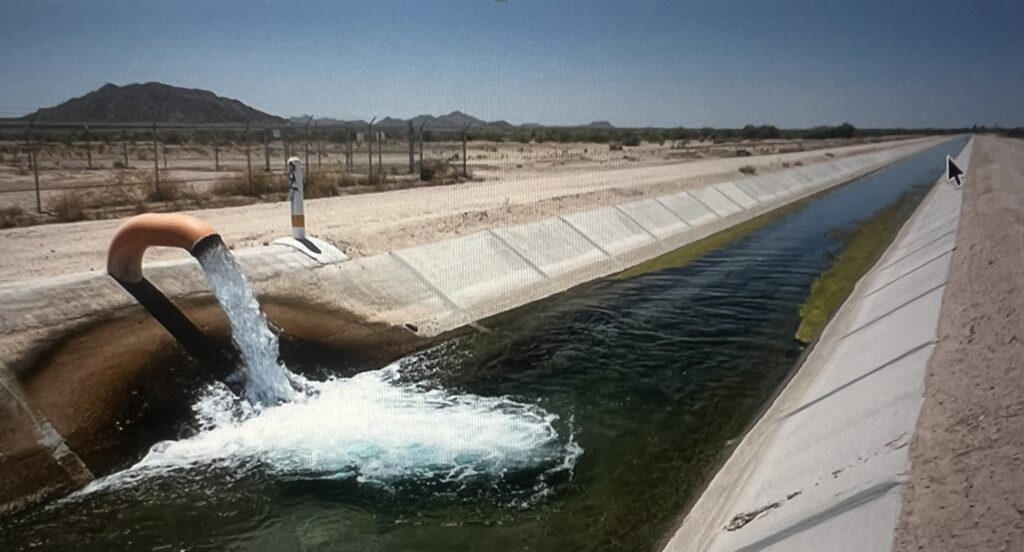
Groundwater makes up the largest portion of the state’s water supply, at around 41%. But recent studies show Arizona has beenlosing groundwater at a rapid pace over the past two decades.
Solutions have remained elusive, owing in part to the competing interests of farmers, conservationists, developers, cities, schools, small towns and the politicians hoping to please them all.
Many hope the outcome of the gubernatorial contest between Hobbs and Biggs, along with some shakeups in the Legislature, could bring meaningful policy changes. But not everyone can afford to be so optimistic.
To regulate or not to regulate
Hobbs made groundwater a priority early in her administration, using the regulatory tools granted to the governor and the Arizona Department of Water Resources by the1980 Groundwater Management Act to circumvent legislative inaction.
Biggs has pledged to make undoing those regulations an early cornerstone of his own potential administration.
“Gov. Hobbs has demonstrated a willingness to be more open to the regulation of groundwater in rural Arizona than is supposed by a Republican governor,” Barnes said. “It’s a fair thing to ponder, and there’s no right or wrong answer.”
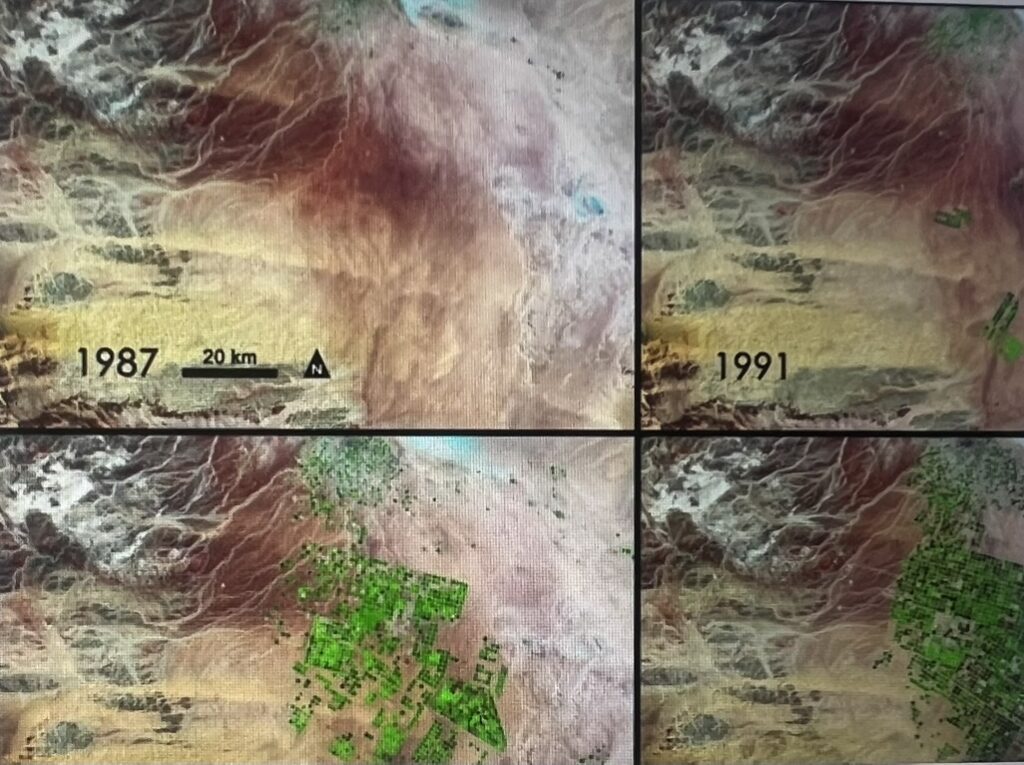
The effects of urban expansion and the extraction of groundwater.
A Maricopa County Superior Court judge agreed and struck down the rule and program earlier this year, though neither ruling has been finalized. While Hobbs and ADWR pledged to explore their legal options, Biggs has promised to throw the regulations out entirely if elected.
“We will codify the repeal of Katie Hobbs’ housing moratorium that cut off the supply of new single-family homes in our fastest-growing areas,” Biggs told reporters on Sept. 22.
Sandy Bahr, the director of the Sierra Club’s Grand Canyon chapter, argues that abandoning the “unmet demand” rule will hurt the state’s ability to manage groundwater in both rural and urban areas.
Republican lawmakers share Biggs’ sentiments, but voters may be more inclined to side with Hobbs. A Center for the Future of Arizona poll showed that 78% of likely voters surveyed favor limiting housing development in areas where a long-term water supply isn’t guaranteed.
In 2024, Hobbs and ADWR also established the Willcox groundwater basin AMA in southeastern Arizona, the first new AMA since the original five in 1980, excepting the voter-established Douglas AMA. That was followed by the creation of a new AMA in western Arizona’s Ranegras Plain in 2025.
Hobbs said she applauds the McMullen Valley group’s efforts, while Biggs said he would be open to hearing their concerns.
In the meantime, some are still holding out hope for the type of negotiations that brought about the creation of the 1980 Groundwater Management Act.
2. Cave Creek Council Approves Water Drought Status, Water-Sharing Initiative. The Cave Creek Town Council approved its 2027 water drought status along with a water-sharing initiative during its meeting Tuesday night.
The Town entered into Response Stage 1 of its Drought Management Plan, initiating a “water watch” stage.
At this stage, town customers are expected to be able to receive most or all of the water they would take in a normal year. Under Response Stage 1, there are no mandatory restrictions, but the plan requires increased water conservation education and outreach. The goal is for customers to voluntarily conserve 3% to 5% of their normal water use.
“Our objective is to stay out of mandatory reductions,” Cave Creek Mayor Robert Morris said. “And by declaring this and focusing on this opinion, this is a way to public help for it if nothing else.”
The declaration comes after the Bureau of Land Management announced a 20% cut of Colorado River water distributed to Arizona.
The Central Arizona Project has worked to make a 14% cut to Cave Creek’s water supply for 2027. The Arizona Water Banking Authority is helping Cave Creek come up with the difference to make sure the town has an adequate water supply.
3. Scottsdale Considers New Restrictions For Large Water Users As Demand Rises. The proposal includes penalties for large water users who violate their conservation plans. The City Council is waiting for final language before voting on it.
The changes under consideration would apply to new large water users, not existing ones.
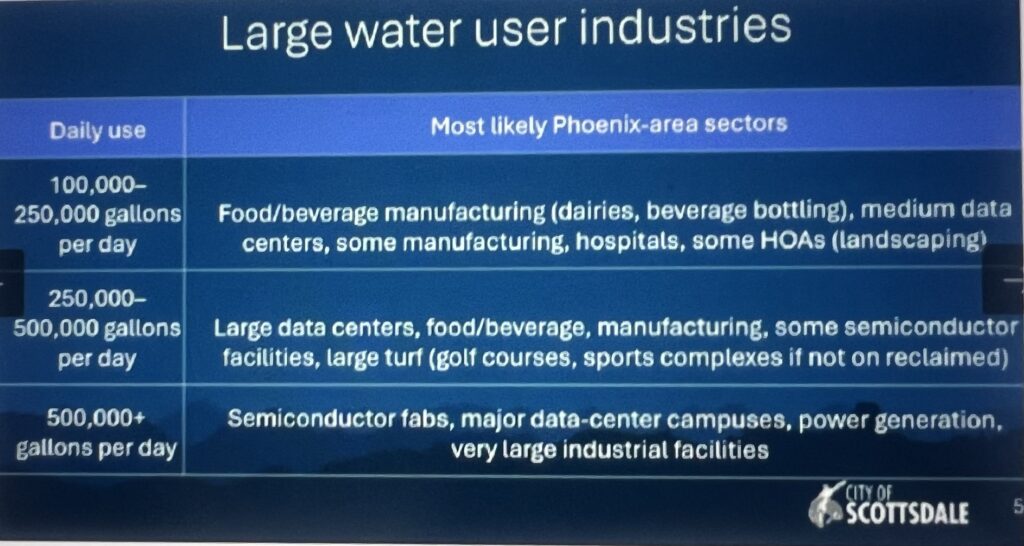
Businesses that use more than 100,000 gallons per day would need to produce a conservation plan.
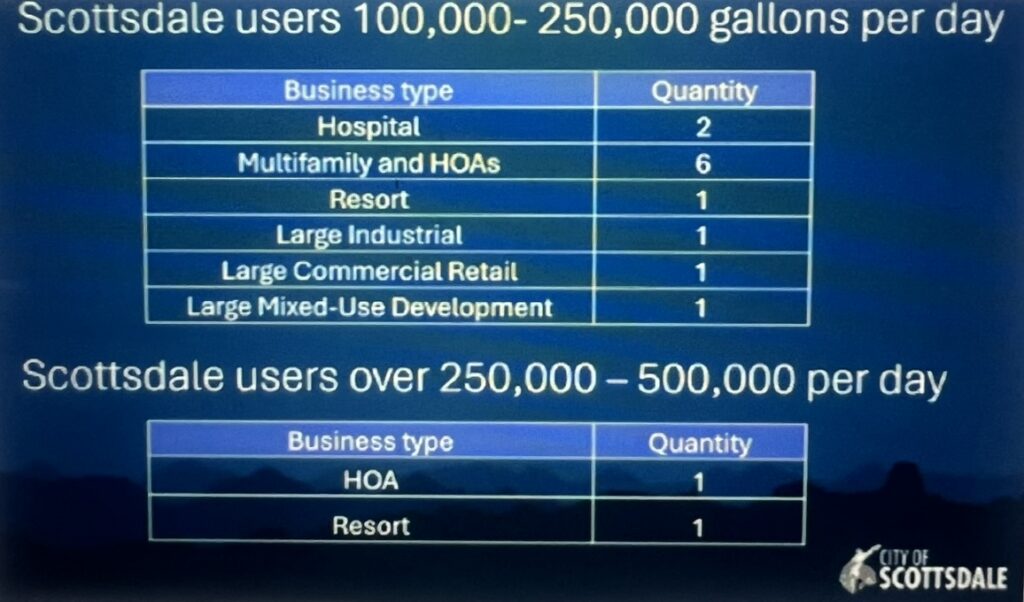
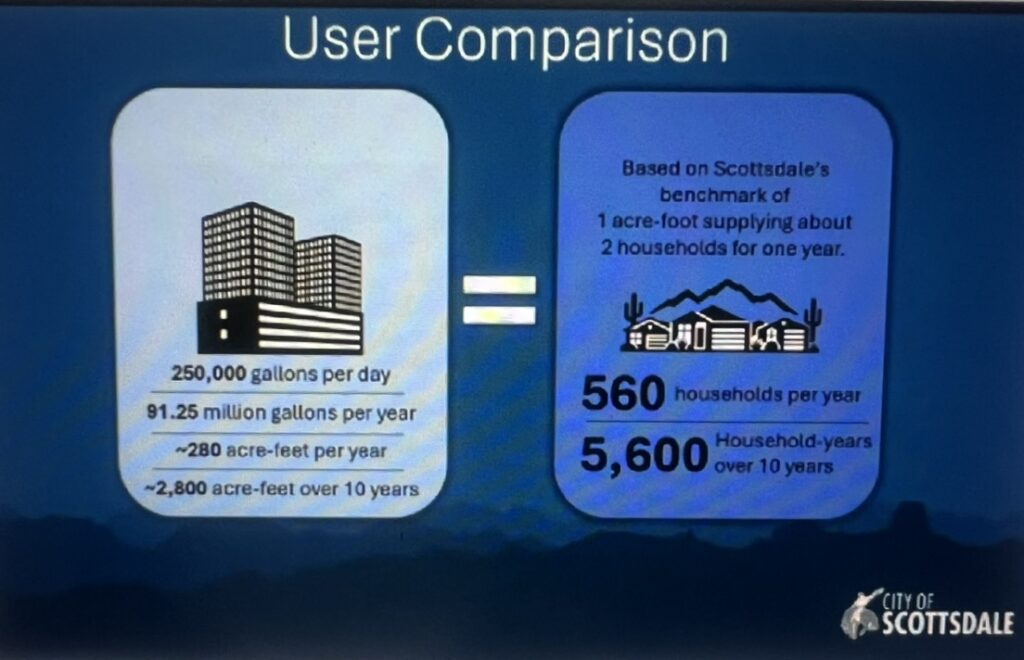
Those that use more than 250,000 gallons per day would need to conduct an economic impact analysis.
And those that use more than 500,000 gallons per day would need additional review and council approval.
Scottsdale currently has 12 entities classified as large water users, none of which use more than 500,000 gallons per day.
These include two hospitals and six multifamily and homeowners associations that use between 100,000 and 250,000 gallons per day.
Two of Scottsdale’s large water users, an HOA and a resort, use between 250,000 and 500,000 gallons per day. Single-family and multifamily residential made up more than 80% of Scottsdale’s water use in 2025.
Borowsky said the goal of updating the large water users ordinance is to avoid imposing water cuts on residents.
However, Councilman Adam Kwasman is worried the updated ordinance will end up regulating homeowners.
“Any type of large-scale plan like this is going to put individual residents and homeowners squarely in the crosshairs, even if they claim they’re not going to do it,” Kwasman said at the meeting.
4. Data Center Boom Brings Health Hazards, Former EPA Officials Warn. Experts warn of dangers from fossil fuel expansion and federal carveouts for the AI industry.
The artificial intelligence boom poses serious health risks while the Trump administration is dismantling crucial safeguards designed to protect the public, according to former officials at the federal agency responsible for environmental protection.
A report released Thursday by the Environmental Protection Network—an organization led by former Environmental Protection Agency staffers—outlines hazards from the rapid rise of data centers. Among those is pollution from increased power demand, which is linked to asthma, cancer, neurological harm and heart and lung disease.
The EPA’s stated mission is to protect human health and the environment. But under President Donald Trump and EPA administrator Lee Zeldin, the federal government has targeted pollution limits and safeguards,weakened enforcement of environmental rules, expanded fossil fuel power generation and moved to give the AI industry dangerous carveouts, experts warn.
“Our government and especially EPA should be making choices that protect people’s health, not choices that leave families carrying more pollution and more risk,” Marc Boom, senior director of public affairs at EPN and a former senior advisor at the EPA, said at a press briefing.

As data center electricity demand grows, the Trump administration is pushing fossil fuel energy over the development of cleaner options. The EPN report outlines 30 federal actions that it says increase pollution-related health risks, though the authors note it’s not an exhaustive list. The actions include extending the life of fossil fuel plants that were soon to be retired, expanding coal while loosening requirements for coal-ash cleanup, rolling back clean air rules and fast-tracking data-center permitting.
“Clean Air Act requirements don’t bend for industry, but they also should not be weaponized,” wrote EPA spokesperson Cora Mandy in an emailed statement. “In each action EPA has taken, the agency has returned regulations to the best reading [of] the Clean Air Act after years of overreach by previous administrations.”
Mandy added that one pillar of the Trump administration’s EPA agenda is to make America “the AI Capital of the World.”
“Data centers and the way that they’re not being regulated are threatening to take us back 200 years by building fossil fuel and polluting infrastructure right on top of where people live,” said Saul Levin, program director at the Center for Nonviolent Conflict Research and host of The Hum, a podcast about data center resistance.
Levin speaks with people opposing data centers across the country and said they often share health-related concerns.
“When it comes to health, people just know that they’re being fed something that’s a bad deal in every way,” Levin said.
More pollution means more missed days of school and work, higher medical bills and more illness and death, the former federal workers wrote in the EPN report. They called on the EPA to put public health ahead of AI expansion by restoring and enforcing pollution safeguards.
“If America is going to undertake an industrial and energy buildout of this magnitude, we should not be taking away the environmental cops’ resources or restricting their ability to act—we should be strengthening the EPA’s ability to hold polluting facilities accountable,” said Larry Starfield, a former principal deputy assistant administrator in the EPA’s enforcement office.
That doesn’t account for recent federal rollbacks, noted Dr. Lynn Goldman, a pediatrician and former EPA assistant administrator.
“These alarming numbers may capture only part of the picture,” Goldman said. “We still do not know the full health toll, and that should argue for more vigilance, not less.”
Although much of the health fallout from policy decisions today will unfold over decades, Goldman noted that some will be immediate, like impacts on pregnant people and fetal development, or heart attacks caused by excessive particulate matter pollution.
5. Self Improvement! Do you know the meaning of “jackanapes”? (/jak-ə-ˌnāpz/) It is a word used to refer to a mischievous or impertinent person, one who is cheeky or disrespectful in behavior that can sometimes border on disrespect. Typically, a jackanapes is someone who defies authority or social norms with a lighthearted attitude. This playful impudence can manifest in various ways, from harmless pranks to witty banter that tests the patience of adults. Source: https://www.wordstrivia.com/trivia/definitions/what-does-jackanapes-mean/results/63041dd4fde3b6ec5970a03c
Copyright 2026 @ EnviroInsight.org
The City Council is waiting for final language from the staff recommendations before it can vote on an updated ordinance. Source: https://ktar.com/arizona-water-news/scottsdale-large-water-users-ordinance
