
Daniel Salzler No. 1363 EnviroInsight.org Six Items June 19 2026
—————Feel Free To Pass This Along To Others——————
If your watershed is doing something you would like others to know about, or you know
of something others can benefit from, let me know and I will place it in this Information .
If you want to be removed from the distribution list, please let me know.
Please note that all meetings listed are open.
Enhance your viewing by downloading the pdf file to view photos, etc.
The attached is all about improving life in the watershed through knowledge.
If you want to be removed from the distribution list,
please let me know. Please note that all meetings listed are open.
Check our website atEnviroInsight.org
1. DOT, EPA, & OSHA Cancel Penalty Increases for 2026
This year, for the first time since 2016, agencies such as US DOT, US EPA, and OSHA will not increase their maximum civil penalties for violations of workplace health and safety regulations.
The law requires these agencies to increase civil penalties annually to keep pace with inflation, and to base that increase on a very specific data point typically provided by the Bureau of Labor Statistics (BLS)—the most recent October Consumer Price Index for All Urban Consumers (CPI-U).
Because funding for the Federal government lapsed in Fall 2025, BLS never produced this information. Trump’s Office of Management and Budget (OMB) sent a memo telling Federal agencies that the 2026 penalty adjustment is cancelled.


Current (2025–2026) Civil Penalty Maximums
US DOT PHMSA
The maximum civil penalties for violations of US hazmat shipping and transportation regulations are:
- $102,348 per day, per violation for failure to provide hazmat training for employees. The minimum penalty for failure to provide hazmat training is $617.
- $102,348 per day, per violation for a hazardous materials violation.
- $238,809 per day, per violation for a violation resulting in death, serious illness, severe injury, or substantial property damage.
US EPA
Major US EPA Programs Current Maximum
- Resource Conservation and Recovery Act $ 93,058
- Clean Air Act (CAA) $124, 426
- Clean Water Act (CWA) $ 68,445
- Superfund and Right-To-Know (CERCLA) $ 71,545
- Safe Drinking Water Act (SDWA) $ 71,545
- Toxic Substances Control Act (TSCA) $ $49,772
- Insecticides, Fungicides and Rodenticides ( FIFRA) $ 24,885
OSHA
Currently, the maximum civil penalty for a willful or repeat violation by an employer is $165,514. The minimum price tag for a willful violation is $11,823. Violations labeled as serious, other-than-serious, “failure to abate,” or “failure to post,” carry a maximum penalty of $16,550. Source: 5/27/2026 by Lion Technology Inc.
2. Lake Powell About 158 Feet Away From “Dead Pool”. After a disappointing winter season, the West faces critical concerns when it comes to water supply.
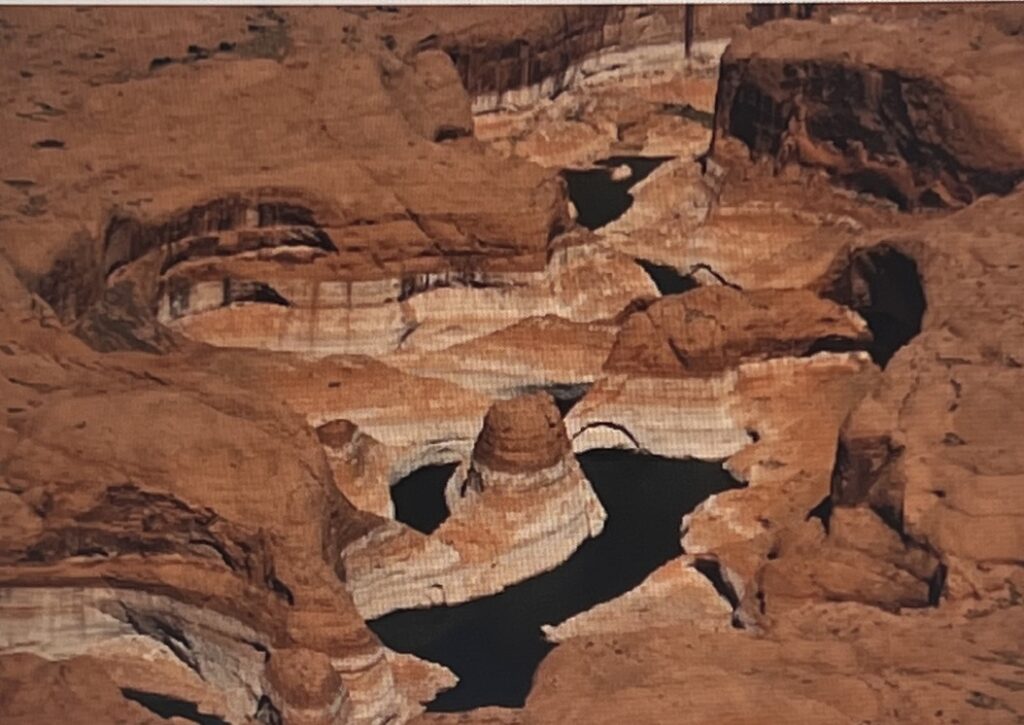
Lake Powell’s water levels remain under pressure heading into summer after a disappointing snow season across much of the Colorado River Basin, raising fresh concerns about water supplies in the Colorado River System, one of the nation’s most important river systems.
The reservoir, which straddles the Arizona-Utah border, depends heavily on spring runoff from mountain snowpack. But this year’s snow season never fully developed across many parts of the West, limiting the amount of water flowing into the Colorado River and its major reservoirs.
Lake Powell and Lake Mead, two of the largest reservoirs that feed the Colorado River system, are both sitting critically low. This week, Lake Powell’s elevation is right around 3,527 feet above sea level, which is only about 158 feet away from “dead pool.” This is the threshold at which the Glen Canyon Dam can no longer generate hydropower.Source: News/Climate June 10, 2026
3. Colorado River Negotiators Made A Rare Public Appearance, But There’s Still No Deal. With a deadline for a new Colorado River plan fast approaching, the states who share its water are still at an impasse, and still repeating many of the same talking points that have emerged during more than a year of unsuccessful negotiations.
Federal officials said they will formalize a plan for dividing the shrinking water supply as soon as mid summer.
That threat hasn’t brought state officials closer to a seven-state agreement that would keep the river working somewhat normally and stave off messy lawsuits between states and the federal government.
Negotiators representing the seven states — Utah, Wyoming, Colorado, New Mexico, Arizona, California, and Nevada — rarely address the public together, but an annual water policy conference in Boulder, Colorado, put two of them on the same stage.
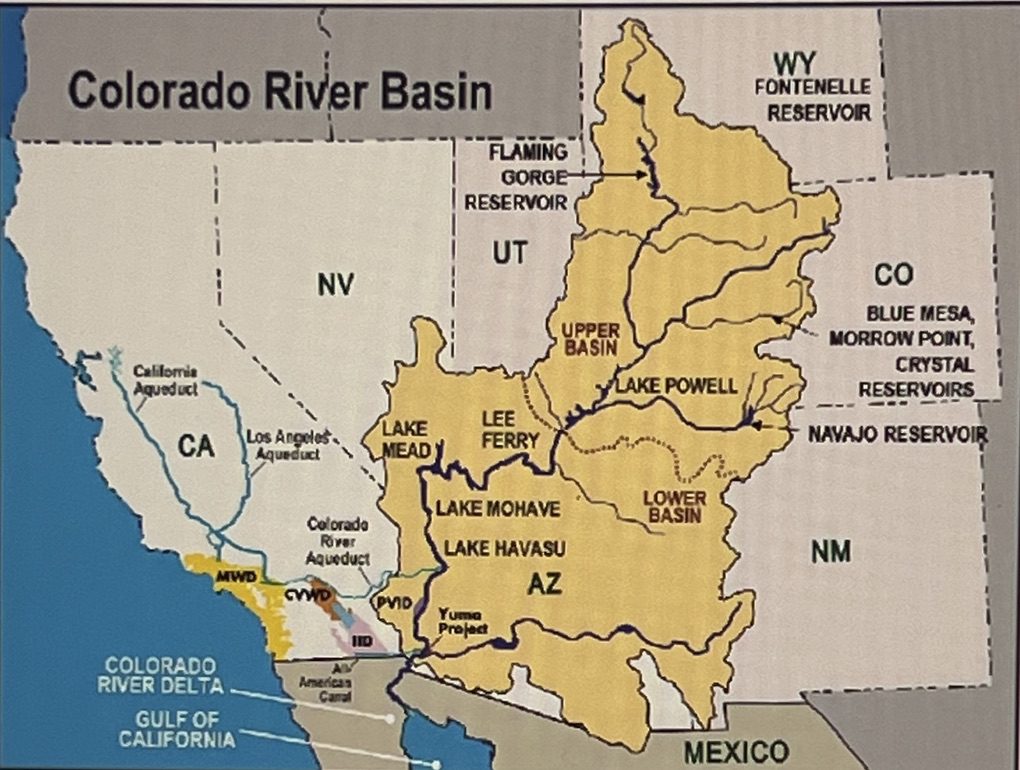
Colorado’s negotiator, Becky Mitchell, and Nevada’s, John Entsminger, spoke to a crowd of policy experts and answered questions from the audience.
Arizona’s top water official, Tom Buschatzke, attended the conference but did not speak publicly.
“I hope you know we’ve been called failures,” Mitchell said. “Just last night, I think we were called failures, all seven of us. Not one of us, not one state, not just the feds, or just the states. We’re called failures.”.
Despite months of negotiations, Mitchell and her allies in Utah, Wyoming, and New Mexico have not put forth a plan to voluntarily cut back on their water use.
Their downstream counterparts in Arizona, California, and Nevada have volunteered some.
“There’s a reasonable, rational operating plan for the next two-plus years right in front of our face, and we should take that,” Nevada’s Entsminger said. “Ultimately, that’s probably the best way to operate the river, and to keep us out of court until 2029.”
That plan would issue steep cuts to some water users in central Arizona, but local water experts say they would be manageable, especially in the short term.
Mitchell pushed back on the proposal, raising concerns that returning to the negotiating table every two years could set the states up for more conflict.
“As we move forward,” she said, “I hope that we can answer the question, not are we building a series of band aids, but are we building some sort of certainty and resilience for the basin and for the future?”
The states seem to be on a crash course for litigation. Negotiators have repeatedly said that they want to steer away from court, but have made little progress on an agreement that would do that steering.

Entsminger and Mitchell addressed the idea of bringing a mediator into their negotiating rooms as a last-ditch attempt to reinvigorate stalled talks.
Entsminger said he would support a setup with three mediators — one picked by the upstream states, a second picked by the downstream states, and a third picked by the first two mediators.
Meanwhile, an expert on U.S.-Mexico water deals opined that the chaos between the states was making it hard for Mexican officials — who sit literally and figuratively downstream of Colorado River decisions made by those states — to plan for the future.
Carlos de la Parra, who served as an advisor during previous water-sharing talks between the U.S. and Mexico, addressed the American negotiators.
“Have you ever wondered what it does to the presence of Mexico in the internal argument of the states?” he asked. “It might be like you get invited to someone’s home, and you sit down and dinner is not ready because there’s an argument going on in the family.”
De la Parra said Mexico has used the time that states have been deadlocked to “improve our game” and work on new strategies for a drier future.
This story was produced by the Mountain West News Bureau, a collaboration between KUNR, Wyoming Public Media, Nevada Public Radio, Boise State Public Radio in Idaho, KUNC in Northern Colorado, KANW in New Mexico, Colorado Public Radio, KJZZ in Arizona and NPR, with additional support from affiliate newsrooms across the region. Funding for the Mountain West News Bureau is provided in part by the Corporation for Public Broadcasting and Eric and Wendy Schmidt.Source: KJZZ June 9, 2026
4. Did You Know……? The United Nations Environment Program has estimated there are between 15 trillion and 51 trillion microplastic particles in our oceans – as much as 500 times the number of stars in our galaxy. Some researches estimate even greater microplastic contamination on land.
There is a growing body of scientific evidence linking, microplastics to a number of human health issues- in particular, to the digestive, reproductive, and respiratory system – as well as threat to wildlife. Learn more at StopMicromonsters.org. Source: Natural Resources Defense Council
5. The Natural Resources Defense Council Is Suing Trump’s EPA over Neonics Use. To insects, neonics are some of the deadliest pesticides ever created. They kill indiscriminately, exterminating not only “pests” but also countless butterflies, bees, earthworms, deer and birds too.
Neonicotinoids (commonly called “neonics”) are a class of synthetic, neuro-active insecticides chemically similar to nicotine. Introduced in the 1990s, they are the most widely used insecticides globally. Neonics are applied to agricultural crops, lawns, and veterinary flea/tick treatments.

In addition, neonics can be applied directly to the soil (as a “drench”) around a plant’s roots or as a coating on a plant seed, which the plant then soaks up as it grows. That makes the plant itself—including its nectar, pollen, leaves, stems, and fruit—toxic. The problem is that only a small portion of the neonics make it into the target plant, leaving the vast majority in the soil. Once in the soil, neonics remain there for years, and rain or irrigation water can easily carry them long distances to contaminate new soil, plant life, and water supplies.
It wasn’t part of the lawsuit brought by NRDC over the EPA’s failure to comply with the endangered species act that led to the agencies, jaw dropping determination that neonics likely harm more than 200 threaten and endangered species.
Now the NRDC has hauled the EPA back to court this time because the agency failed to respond to petition calling on it to revoke its ”food tolerances” neonics – the maximum level of pesticide residue allowed on food – because the current tolerances failed to protect public health. It is believed that 50% of the human population have neonic’s in their body, mainly in children. The neon’s travel from the seed to the plant, to the fruit or vegetable that we consume. New York State, Maine, Nevada, New Jersey and Vermont has banned or seriously restricted neonicotinoid use on lawn and garden use. One corn seed, treated with neonicotinoid, can kill a quarter million bees or more. New York: Enacted a major ban on the sale and purchase of neonic-treated corn, soybean, and wheat seeds. Vermont: Phased out the use of neonic-treated field crop seeds and Minnesota: Banned neonicotinoid use on all state-managed public lands. Colorado farmers are offered a financial incentive to NOT use neonicotinoid treated seeds and sprays.
Currently home owners can purchase BEE – SAFE herbicides including Spruce Weed and Grass Killer and ECO Garden. Boiling water also works well to kill weeds.
Perhaps Arizona should consider a neonicotinoid ban. Source: NRDC, Editor
6.ADEQ Expands Arizona’s Fish Consumption Advisory Program To Include PFOS. The Arizona Department of Environmental Quality (ADEQ), in coordination with the Arizona Department of Health Services (ADHS) and the Arizona Game and Fish Department (AZGFD), will start issuing perfluorooctanesulfonic acid (PFOS) Fish Consumption Advisories this summer through the Arizona Green Light Fisheries & Fish Consumption Advisory program. ADEQ will be providing updated consumption guidance based on recent analysis of data that indicate elevated levels of PFOS in fish tissue in certain locations.
PFOS Fish Consumption Advisories are based on guidance from the Great Lakes Consortium for Fish Consumption Advisories. PFOS is part of a larger class of chemicals known as per- and polyfluoroalkyl substances (PFAS). ADEQ worked with ADHS to review the scientific thresholds and ensure the guidance reflects current public health recommendations.
ADEQ is committed to providing transparent, science-based information that communities can use to protect their health,” said Randy Matas, Acting Water Quality Division Director. “By adding PFOS to our existing advisory system, we are giving anglers clear guidance.”
PFAS fish tissue monitoring was made possible by Governor Katie Hobbs providing American Rescue Plan Act (ARPA) funding. The funding allowed ADEQ to include PFOS in the existing suite of contaminants that the agency already samples at many of Arizona’s most-visited lakes, rivers, and streams.
Fish consumption advisories address potential long-term exposure from eating fish and do not address recreational water use. According to the ADHS, PFAS absorption through skin is minimal, so activities like swimming, wading, and catch-and-release fishing pose little risk. However, watch kids carefully if you think they may swallow water while swimming.
As part of the ARPA funded PFAS monitoring project, ADEQ continues to test fish tissue from more than 25 lakes, focusing on the state’s most recreated sites. Fish tissue samples are tested for 40 types of PFAS in addition to mercury already included in the Arizona Green Light Fisheries & Fish Consumption Advisory program. At the conclusion of the project, ADEQ will release a comprehensive report and upload the fish tissue data to the U.S. Environmental Protection
Agency’s water quality database, where it will be publicly available.
Community members are encouraged to check the Green Light Fisheries & Fish Consumption Advisories before they fish and use the information to guide whether and how often they consume certain fish species.
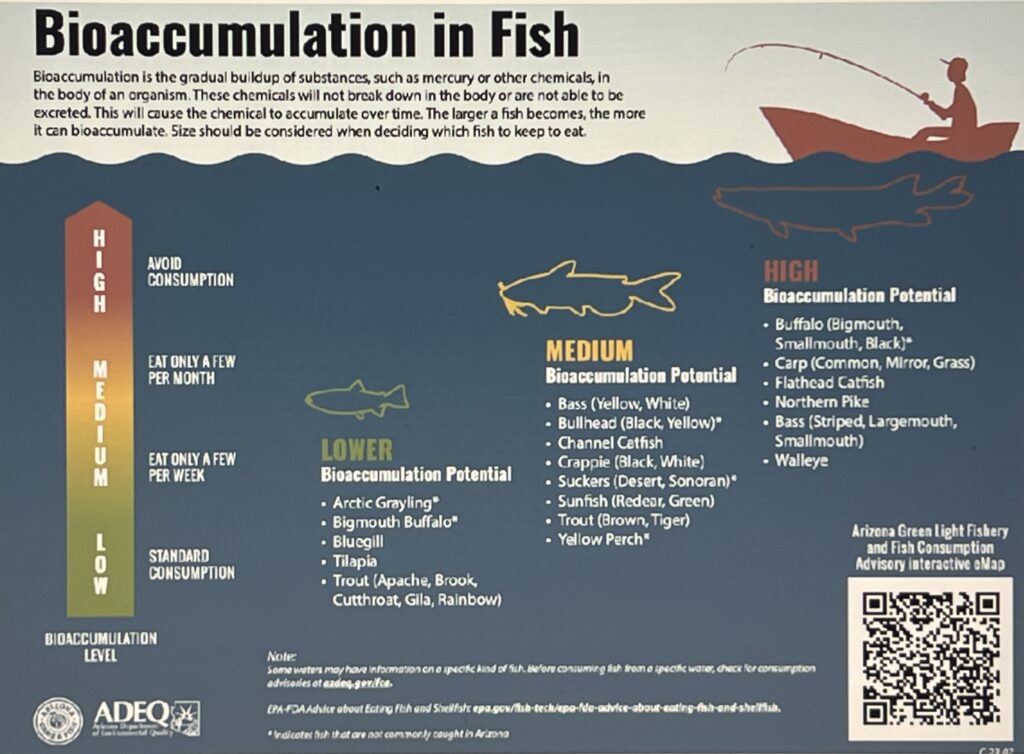
Fishing is an important part of life for many Arizonans and supports recreation, tourism, and local economies. Fish are high in protein and provide important nutrients, including omega-3 fatty acids. However, some contaminants can accumulate in fish over time, which is why ADEQ monitors fish tissue and provides consumption guidance to help people make informed choices. Choose to consume fish with lower bioaccumulation factors, such as trout | See More >
- Eat younger fish, which are smaller and typically have lower levels of contaminants since they have not lived in the water as long as larger, older fish.
- Remove organs and trim away the skin where contaminants often concentrate.
- Eat fish from different locations.
- Practice catch-and-release.
- Prioritize consuming stocked fish, as their controlled diet and shorter time in the wild lead to lower bioaccumulation.
PFAS are a group of man-made chemicals with fire-retardant properties manufactured and used by various industries since the 1940s. PFAS have been used in many industrial processes as well as to make products such as stain and water-resistant carpets and clothing, food packaging, and firefighting foam. Often called forever chemicals, PFAS are hard to break down and stick around in the environment and our bodies for a very long time. While scientific research into how PFAS affects human health is ongoing, exposure to PFAS has been linked to serious health effects, including certain cancers, immune system disruption, and developmental issues.
- ADEQ Green Light Fisheries and Fish Consumption Advisory eMap | View eMap >
- AZGFD Fish Consumption Advisories for Arizona Waters | View AZGFD Advisories >
- ADEQ Bioaccumulation in Fish | View Fact Sheet > | View Infographic >
- ADHS PFAS Webpage | View PFAS Page >
- ADEQ Expands Monitoring for PFAS to Protect Public Health Press Release | View Press Release >
- Arizona Green Light Fisheries & Fish Consumption Advisory Program | View Page >
- Great Lakes Consortium for Fish Consumption Advisories | View Guidance >
Contact: ADEQ Public Information Officer 480-670-0568 | Email PIO >
Copyright 2026@ EnviroInsightrg
